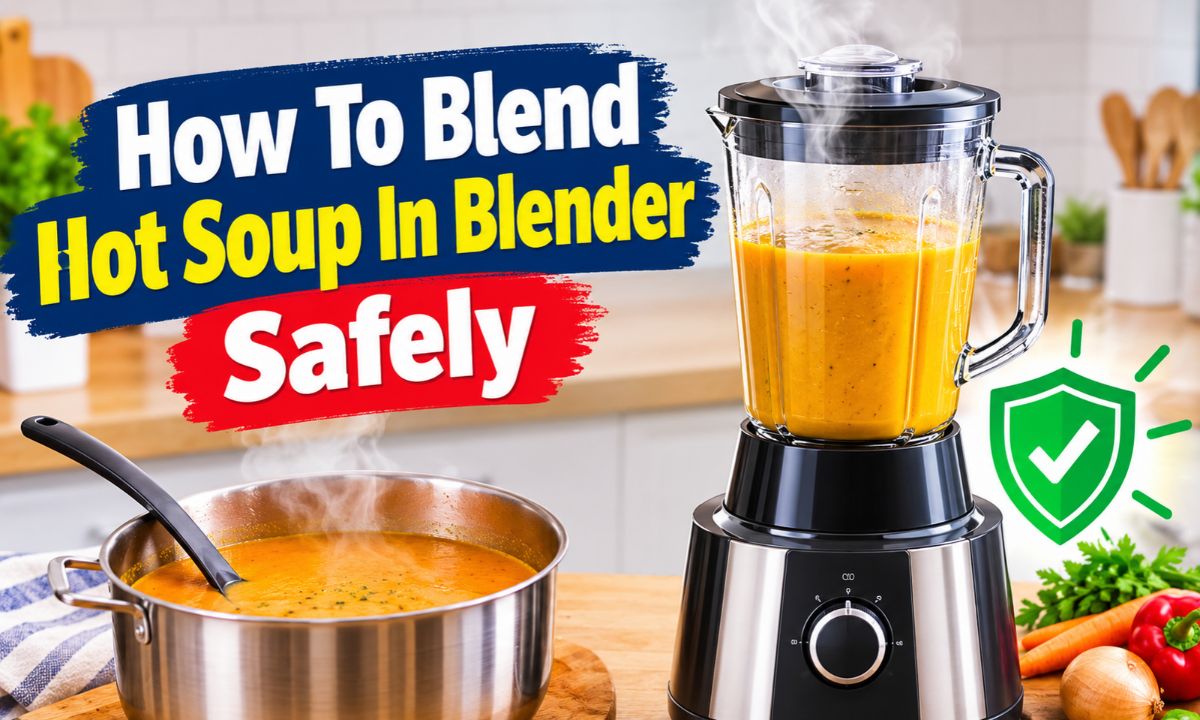
Let the soup cool slightly, check that your blender can handle hot liquids, work in small batches, vent steam safely, and start on low speed.
Across American homes, a warm bowl of tomato soup, potato soup, or butternut squash soup is a simple comfort on a cold day. A countertop blender can turn cooked vegetables and broth into a smooth meal, but hot soup needs extra care. Steam can build pressure inside a closed blender jar. When that pressure forces the lid loose, hot liquid may spray onto your hands, face, or nearby surfaces.
The safest method depends on your blender type and its instructions. Some countertop blenders allow hot ingredients when used with a vented lid and small batches. Others are intended for cold liquids or have limits on temperature and fill level. An immersion blender can be easier for soup because you can blend it in the cooking pot, provided the tool is rated for hot food and remains fully submerged. This guide explains how to choose a method, blend with care, fix common problems, and serve smooth soup without avoidable splashes.
Hot soup can release steam even after you remove it from the stove. When you seal hot liquid inside a blender jar, the steam has less room to escape. The pressure can rise as the motor mixes the soup and moves hot air through the container.
If pressure builds under a tightly closed lid, the lid may lift or hot soup may escape around its edges. A sudden splash can cause a serious burn. The risk grows when the jar is too full, the soup is near boiling, or the blender is not designed for hot ingredients.
Blending also creates movement inside the jar. Thick soup can rise along the sides, form a central dip, or push against the lid. A high speed may make these effects stronger. That is why a safe fill level, a suitable lid, and a low starting speed all matter.
The goal is not simply to make the soup smooth. It is to control heat, steam, and movement while the blades work. A little patience at the start can prevent a painful mess and protect the blender from damage.
Source: reviewmast.com
Steam pressure
Hot liquid releases vapor. A sealed container may trap that vapor and create pressure that pushes against the lid.
Hot splashes
Fast-moving soup can escape through a lid opening or overfill the jar, exposing skin to hot liquid.
Container limits
A jar that works well for cold smoothies may have different temperature or fill restrictions for hot soup.
Check Your Blender Before Adding Hot Soup
Start by checking the owner’s manual for instructions on hot liquids. Look for temperature limits, maximum hot-liquid capacity, lid requirements, and any directions for venting steam. If the manual says not to blend hot ingredients, let the soup cool to the permitted temperature or use a suitable alternative.
The material of the jar alone does not prove that it is safe for hot soup. A glass jar may resist heat but still have limits related to sudden temperature changes. A plastic jar may be suitable for hot liquids if its manufacturer says so, while another plastic jar may be intended for cold use only.
Check the lid, gasket, and jar for cracks, chips, loose parts, or damage. Make sure the jar sits securely on its base and that the blade assembly is properly fitted. A damaged seal or unstable container can allow liquid to escape during blending.
If you cannot find reliable instructions for your model, do not guess. Allow the soup to cool and use a method that the manufacturer explicitly approves. A short pause is better than risking a spill of hot liquid.
Source: stripedspatula.com
Read the manual
Confirm whether hot liquids are allowed and follow the exact fill, temperature, lid, and speed instructions for your model.
Inspect the jar
Look for cracks, chips, worn seals, and loose parts before adding any food.
Check the lid design
Find out whether the lid has a removable center cap or another approved way to release steam.
Confirm the fill line
Use the hot-liquid limit when one is provided. Do not rely on the jar’s general maximum capacity.
Can Every Blender Handle Hot Liquids?
No. Some countertop blenders are designed to process hot ingredients, while others are not. The answer depends on the specific model, its jar, and its lid. Even within one product range, instructions may differ.
A blender’s ability to crush ice or make thick smoothies does not establish that it can safely process hot soup. If the manufacturer prohibits hot liquids, do not use a workaround such as leaving the lid partly loose unless the instructions explicitly permit it.
Countertop blender
Use for hot soup only when the model’s instructions allow it and you can follow its venting and fill requirements.
Immersion blender
Use a model rated for hot food. Its blade guard must stay submerged during operation, and the pot must be stable.
Personal blender
Many personal cups are intended for cold drinks. Do not put hot soup into one unless the manufacturer clearly approves it.
How To Blend Hot Soup In Blender Safely Step by Step
The safest process begins before you turn on the motor. Prepare a clear work area, check your equipment, and decide how much soup to blend at one time. Keep children and pets away from the counter while you handle hot food.
If the soup is bubbling hard or releasing a large amount of steam, remove it from the heat and allow it to cool until it is suitable for your blender. There is no single cooling time for every recipe because the amount of soup, pot size, room temperature, and starting heat all affect how quickly it cools.
Once the soup is ready, follow the steps below. The exact lid and venting method must match the instructions for your model. Never treat a generic technique as permission to use a blender that is not rated for hot ingredients.
Source: blenderjunkie.com
Step 1: Prepare the work area
Place the blender on a dry, level, stable counter. Keep towels, loose cords, and clutter away from the jar and base.
Step 2: Let the soup cool as needed
If the soup is boiling or steaming heavily, let it cool before blending. Follow the temperature limit in the manual.
Step 3: Transfer a small batch
Use a ladle or heat-safe pouring tool to move the soup into the jar. Avoid lifting a heavy, full pot over the blender.
Step 4: Stay below the hot-liquid fill limit
Leave enough space for the soup to move. If there is no clearly stated safe hot-liquid capacity, do not estimate one for a model with uncertain hot-liquid suitability.
Step 5: Fit the lid as directed
Use the approved lid and steam-venting method. If the manual calls for removing a center cap, follow its instructions for keeping the opening covered safely without sealing in pressure.
Step 6: Start at low speed
Turn the blender on at its lowest setting. Keep your face and hands away from the lid and vent.
Step 7: Increase speed slowly if needed
Raise the speed only when the manual allows it and the soup is moving without splashing or forcing the lid upward.
Step 8: Stop before checking the texture
Switch off the motor and wait until the blades stop. Follow the manufacturer’s instructions before opening or removing the lid.
Step 9: Transfer the soup carefully
Pour slowly into a stable bowl or clean pot, keeping your hands away from hot liquid and steam.
How to Vent Steam Without Causing Splashes
Some countertop blenders have a removable center cap designed to let steam escape. If your manual directs you to remove it, do so before starting the motor. Follow the stated method for covering the opening, if any, and use a folded towel only as directed by the manufacturer.
Never press your bare hand directly over an open vent while the blender runs. Steam can burn skin, and soup may escape through the opening. Do not assume that holding the entire lid down will make an otherwise unsafe setup acceptable.
If your blender has a sealed lid with no approved hot-liquid venting method, do not improvise. Let the soup cool to the manufacturer’s permitted temperature or choose an appropriate immersion blender.
Keep your face back
Position yourself away from the steam outlet and avoid leaning over the jar.
Follow the model-specific method
Lid designs vary, so use the manufacturer’s instructions rather than copying a method meant for another blender.
How Much Hot Soup Should You Put in a Blender?
Blend hot soup in small batches and stay within the manufacturer’s hot-liquid limit. A large batch can leave too little room for steam and moving liquid, which increases the chance of splashing or pressure-related problems.
The safe amount varies by blender model and soup type. A thick puree, such as potato soup, may move differently from a thin broth. A jar that is suitable for a cold smoothie may also have a lower permitted fill level when used with hot ingredients.
Do not use the maximum fill line as an automatic target. If the manual gives a separate hot-liquid line, use that line. If it does not explain how much hot soup the jar can hold safely, contact the manufacturer or choose a method with clear instructions.
Source: theculinarygene.com
Use the marked limit
Follow the lower hot-liquid limit when the manufacturer provides one.
Leave room for movement
Avoid filling the jar to the top, even if the soup looks calm before the motor starts.
Divide large batches
Blend one batch at a time and return the finished soup to a clean pot if you need to combine several portions.
Avoid guessing
There is no universal safe cup measurement for all blenders. The model’s instructions determine the permitted amount.
What If You Have a Large Pot of Soup?
Do not try to move the whole pot into a countertop blender at once. Set the pot on a stable surface and transfer manageable portions with a ladle. Keep the pot handle turned away from the edge of the counter so it is less likely to be knocked over.
If the recipe makes a large amount, an immersion blender may save time because it can process the soup in the cooking pot. Check that the pot is deep enough to keep the blade guard submerged, and avoid touching the hot sides of the pot while blending.
Small kitchen
Use a stable counter and set a heat-safe bowl nearby to hold the blended portions.
Large family batch
Consider a suitable immersion blender or process the soup in several countertop batches.
Countertop Blender vs. Immersion Blender for Hot Soup
Both countertop and immersion blenders can make smooth soup when the device is suitable for the task. The main difference is where the blending takes place. A countertop blender uses a separate jar, while an immersion blender works directly in a pot or another suitable container.
An immersion blender can reduce the need to pour hot soup between containers. That may make it easier to process a large pot of vegetable soup or sauce. However, it can still splash if the blade guard comes above the liquid or the user moves the tool too quickly.
A countertop blender can produce a smooth result for many soups, but it requires careful batch control and proper steam venting. The best choice depends on the equipment you own, the amount of soup, and the texture you want.
Source: ansoup.com
Countertop blender
Useful when the manufacturer permits hot liquids and you want to process measured batches in a closed jar with an approved venting setup.
Immersion blender
Useful for blending soup in the cooking pot, reducing transfers. Keep the blade guard submerged and follow the tool’s hot-food instructions.
Food processor
Do not assume it can handle hot soup. Many food processors have different lid and liquid restrictions, so check the manual before using one.
How to Use an Immersion Blender Safely
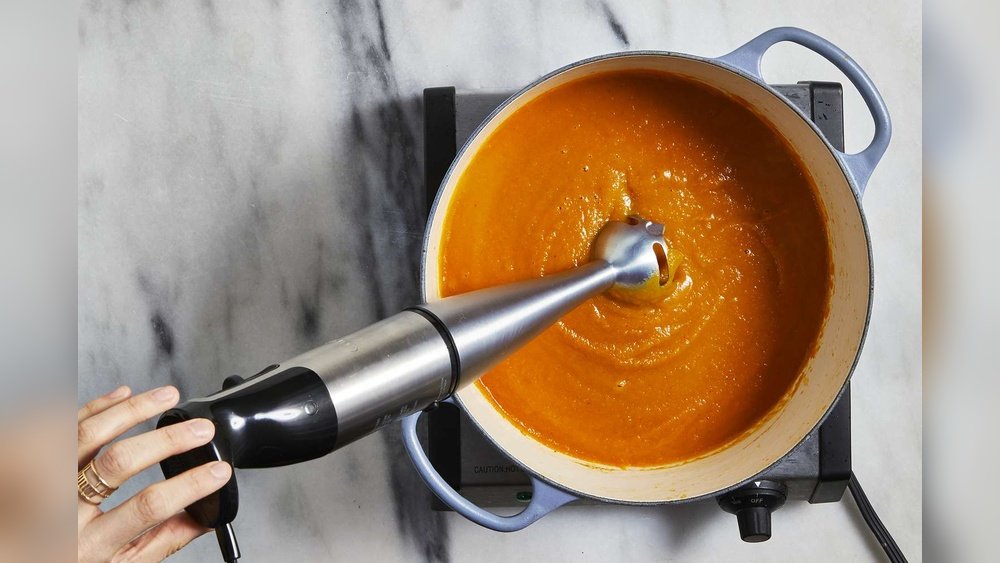
Turn off the heat before blending unless the manufacturer specifically permits another method. Place the blender head into the soup before turning on the motor. Keep the blade guard fully submerged and point it away from the surface to reduce splashes.
Start at low speed and move the tool slowly through the soup. Avoid lifting the running blade above the liquid. If you need to reposition it, switch the motor off first, then move the head to the new spot.
Use a deep pot that leaves room for the soup to move. A shallow pan can allow hot liquid to splash over the edge. Keep the power cord away from the stove, hot surfaces, and the pot’s rim.
Submerge before starting
Place the blade guard into the soup before switching on the motor.
Move slowly
Use gentle up-and-down or side-to-side movements while keeping the guard below the surface.
Switch off before lifting
Turn off the motor before removing the blade from the soup or scraping food from the head.
Tips for Getting Smooth Soup Without Overworking the Blender
A smooth soup depends on the ingredients as well as the blending method. Cooked vegetables should be tender enough for the blades to break them down. Large chunks of carrot, potato, or squash can leave an uneven texture if they are too firm or too large.
Add enough broth or other recipe liquid to help the ingredients circulate. A very thick mixture may stall or move poorly. If the soup is too thick, stop the blender before adding more liquid, then follow the manual’s directions for restarting.
Blend only as long as needed to reach the texture you prefer. Some soups benefit from a completely smooth finish, while others taste better with a little texture. You can also reserve a portion of cooked vegetables and stir them into the finished puree.
If the soup contains cream, milk, or cheese, consider blending the cooked vegetables and broth first, then stirring in the dairy afterward if the recipe allows. This can help limit excess foam and makes it easier to adjust the final texture. Keep the soup at a safe serving temperature and follow the recipe’s cooking instructions.
Source: ansoup.com
Cook vegetables until tender
Soft vegetables are easier to puree than firm chunks and can help reduce the time needed for blending.
Add liquid carefully
Use broth, water, or another recipe liquid to loosen a thick soup. Stop the motor before adjusting the mixture.
Avoid overfilling
Give the ingredients room to circulate so the mixture does not press against the lid.
Adjust texture after blending
Stir in reserved vegetables, cooked grains, or other prepared ingredients after the puree is smooth.
What to Do With Thick or Fibrous Soup
Thick soups may need more liquid to move well. Turn off the blender before opening it or adding ingredients, and follow the model’s instructions for safe access to the jar. Never push a spoon or spatula into a jar while the blades are moving.
Fibrous ingredients, such as celery strings or some leafy vegetables, can leave small strands behind. Cook them until tender, cut them into manageable pieces before blending, and strain the finished soup if a very smooth texture is needed.
If the blades seem stuck
Stop the motor and disconnect power before inspecting the mixture. Do not force the blades by hand while the jar is attached to the base.
If the soup is too thin
Return it to the pot and simmer according to the recipe, or add an appropriate thickening ingredient. Do not reduce soup in the blender.
Common Mistakes to Avoid When Blending Hot Soup
Most avoidable blending problems begin with a mismatch between the soup and the appliance. A blender may handle a cold drink well but still be unsuitable for boiling liquid. Check the manual before you start, rather than relying on appearance or motor power.
Another common mistake is filling the jar too high. Soup expands in motion and can rise toward the lid. Small batches provide more control and make it easier to stop if the mixture begins to splash.
Do not tighten a lid that is supposed to vent steam, and do not remove a lid while the motor is running. Both actions can expose you to hot liquid. Wait until the blades stop and follow the manufacturer’s opening instructions.
Never use a spoon, knife, or other utensil to push ingredients toward moving blades. If food is stuck, turn off the motor, unplug the blender, and wait for all moving parts to stop before checking the jar.
Source: kitchenwink.com
Using boiling soup without checking the instructions
Allow the soup to cool as needed and confirm that the blender is approved for the temperature and amount.
Sealing in steam
Use only the approved lid and venting setup for hot ingredients.
Starting at high speed
Start low and increase speed gradually only when the manual allows it.
Holding an unsafe lid in place
Do not rely on hand pressure to compensate for a lid or jar that is not suitable for hot liquids.
Removing the lid too soon
Switch off the motor, wait for the blades to stop, and open the jar using the method described in the manual.
Moving the blender while running
Keep the appliance stable and do not lift, tilt, or carry a running countertop blender.
What If Soup Starts Leaking or the Lid Moves?
If the lid begins to lift, liquid escapes, or the blender shakes more than expected, stop the motor immediately if you can do so without reaching through a splash or steam plume. Step back from the jar and allow the appliance to stop.
Do not try to push down a moving lid or grab a leaking jar. Wait until the motor has stopped and the immediate danger has passed. Follow the manual’s directions for unplugging and handling the appliance, keeping your face and hands away from hot liquid.
Once the setup is safe to inspect, check whether the jar was overfilled, the lid was fitted incorrectly, or the soup was too hot. If the appliance is cracked, damaged, or behaving abnormally, stop using it until the problem has been resolved.
Stop and step back
Avoid contact with escaping steam or hot soup.
Wait for all motion to stop
Do not open or adjust the jar while the motor is running.
Correct the cause before restarting
Reduce the batch size or let the soup cool further, and verify the lid and fill instructions.
Troubleshooting Common Hot Soup Blending Problems
When blending does not go as planned, turn off the motor before checking the soup or the appliance. Do not open the jar, reach toward the blades, or add ingredients while the motor is running. If hot liquid is leaking, step back and wait until the immediate danger has passed.
A problem may come from the soup’s thickness, the batch size, the blade assembly, or the appliance itself. Check the simplest and safest causes first. If you smell burning, see smoke, hear a new grinding noise, or notice a damaged cord, stop using the blender and follow the manufacturer’s service guidance.
Source: stripedspatula.com
The soup is chunky
The vegetables may be undercooked or the batch may be too thick. Stop the blender, allow safe access to the jar, and adjust the ingredients as directed by the manual.
The soup splashes toward the lid
The batch may be too large, the speed may be too high, or the soup may be too hot. Stop, let it settle, and correct the setup before trying again.
The blades do not seem to move the soup
The mixture may be too thick or the ingredients may be trapped. Stop the motor and unplug the unit before checking for a blockage.
The soup is foamy
Fast blending can incorporate air. Use a lower speed when permitted and let the soup rest briefly before serving.
The blender smells hot or makes unusual sounds
Stop using it. Disconnect power when safe, let the appliance cool as directed, and inspect it only after it is safe to handle.
The soup remains uneven after blending
The vegetables may need more cooking or the soup may contain tough fibers. Correct the preparation and blend another small batch if the appliance and mixture are safe to process.
How to Clean the Blender After Making Hot Soup
Clean the blender after the soup has been transferred and the appliance is safe to handle. Switch off and unplug the unit before removing parts or reaching near the blade assembly. Be careful because the jar, lid, and soup residue may still be hot.
Follow the cleaning instructions for your exact model. Some jars and lids can go in a dishwasher, while others require hand washing. Never immerse a motor base in water, and do not assume that every blade assembly can be removed safely.
If the manufacturer permits rinsing the jar with warm water and a small amount of dish soap, use that method to remove residue. Avoid filling the jar with hot water and running it at high speed unless the manual specifically permits that cleaning process.
Pay attention to the lid, vent, and gasket. Soup residue can collect in small openings, especially when the recipe contains cream or starchy vegetables. Let removable parts dry fully before storing them, and inspect seals for wear.
Source: theculinarygene.com
Disconnect power
Unplug the blender before removing parts or cleaning near the blades.
Use approved cleaning methods
Check which parts are dishwasher-safe and whether the blade assembly can be removed.
Clean the vent and lid
Remove visible food residue without forcing tools into openings or damaging seals.
Inspect before storage
Check for cracks, worn gaskets, and damage that could affect safe use during the next batch.
Serving and Storing Blended Soup Safely
Once the soup is smooth, transfer it carefully to a serving bowl or pot. Use a stable surface, keep the container close to the blender jar, and pour slowly. Do not hold your face over the opening or reach across a stream of hot soup.
Taste and adjust the seasoning after blending, since pureeing can change how the flavors and texture come together. If you want to add cream, herbs, or a garnish, stir them in after the soup is out of the blender when the recipe permits.
If you are not serving the soup right away, do not leave it at room temperature for an extended period. Divide large amounts into shallow containers so they can cool more quickly, and refrigerate promptly according to current food safety guidance. Avoid placing a very hot, tightly covered container in a way that traps excess heat or creates a handling hazard.
For leftovers, use clean containers and label them with the preparation date. Reheat only the portion you plan to eat and follow food safety guidance for storage and reheating. A safe blending process is only one part of preparing soup; handling and storing the finished meal also matter.
Source: blenderjunkie.com
Pour slowly
Keep the receiving container stable and avoid sudden movements that could spill hot soup.
Cool leftovers promptly
Use shallow containers and refrigerate leftovers within two hours, or within one hour when the surrounding temperature is above 90°F, in line with USDA guidance.
Reheat leftovers thoroughly
For leftovers, USDA guidance recommends reheating to 165°F. Use a food thermometer to check the temperature.
Avoid repeated heating and cooling
Reheat only what you need when practical, and return remaining portions to safe storage promptly.
A Quick Safety Checklist Before You Blend
Use this checklist each time you prepare hot soup in a countertop blender. It helps you catch common risks before the motor starts. If any essential safety condition is uncertain, pause and check the manual rather than improvising.
Source: ansoup.com
Equipment approved
The manufacturer allows hot liquids at the soup’s temperature.
Jar and lid intact
No cracks, loose seals, or damaged components are present.
Soup ready
The soup is not boiling vigorously and is within the permitted temperature range.
Batch size controlled
The amount of soup is below the hot-liquid fill limit.
Steam vent handled correctly
The lid and vent are configured exactly as the manufacturer directs.
Speed controlled
The blender will start at a low setting if the model’s instructions permit that method.
Work area clear
The base is stable, the counter is dry, and children and pets are away from the appliance.
Transfer and cleanup planned
A stable receiving container is ready, and the appliance can be unplugged before cleaning.
Frequently Asked Questions
Q
Can I put boiling soup straight into a blender?
Do not put boiling soup into a blender unless the manufacturer explicitly permits that temperature and provides instructions for safe use. Many models require the soup to cool first. Even with a hot-liquid-rated blender, follow its fill limit, venting method, and speed instructions.
Q
Should I leave the blender lid open when blending hot soup?
Do not simply leave the lid open or remove it while the motor runs. Some countertop blenders require a specific venting setup, such as removing a center cap while keeping the lid in place. Use that method only if the manufacturer instructs you to do so. An unsuitable lid or jar should not be used for hot soup.
Q
How long should I let soup cool before blending?
There is no fixed cooling time for every soup or blender. A small amount in a wide pot may cool faster than a large batch in a deep stockpot. Let the soup cool until it meets the temperature limit in the manual, and do not rely on a set number of minutes as proof that it is safe.
Q
Can I blend hot soup in a plastic blender jar?
You can do so only if the manufacturer rates that specific jar and blender for hot liquids. Plastic construction alone does not confirm heat resistance, and glass construction alone does not guarantee safety against thermal shock. Check the temperature limit and follow the instructions for the entire assembly.
Q
Is an immersion blender safer for hot soup?
An immersion blender can reduce the need to pour hot soup into a separate jar, which removes one handling step. It can still splash or cause burns if the blade guard rises above the liquid or the tool is moved too quickly. Use a model rated for hot food, choose a deep stable pot, and keep the blade guard submerged while running.
Q
Can I blend hot soup in a personal smoothie blender?
Only if the manufacturer specifically approves hot liquids for that model and cup. Many personal blenders use tightly sealed cups that are not designed for hot ingredients. Heat and steam can increase pressure inside a sealed cup, so never assume that a smoothie container is suitable for soup.
Q
What should I do if hot soup splashes onto my skin?
Move away from the blender and cool the burn under cool running water for 20 minutes. Do not apply ice, butter, or greasy creams. Remove nearby jewelry or clothing unless it is stuck to the skin. Seek urgent medical care for deep or large burns, burns on the face or hands, or other serious injuries. Call emergency services if the injury is severe.
✦ Wrapping Up
Conclusion
Blending hot soup can be simple when you use the right equipment and control the heat, steam, and batch size. Check the manual first, let the soup cool as needed, and follow the approved lid and venting method. Start at low speed when permitted, keep the jar below its hot-liquid fill limit, and stop the motor before opening it.
For large pots, an immersion blender may reduce the need to transfer hot liquid, but it still requires care. Keep the blade guard submerged, move the tool slowly, and turn it off before lifting it from the soup. If your blender’s hot-liquid limits are unclear, let the soup cool and confirm the correct method before proceeding.
💡 Key Takeaway
Before blending your next pot of soup, check the manual for hot-liquid instructions, prepare a small batch, and confirm that the jar, lid, vent, and fill level are suitable for the task.