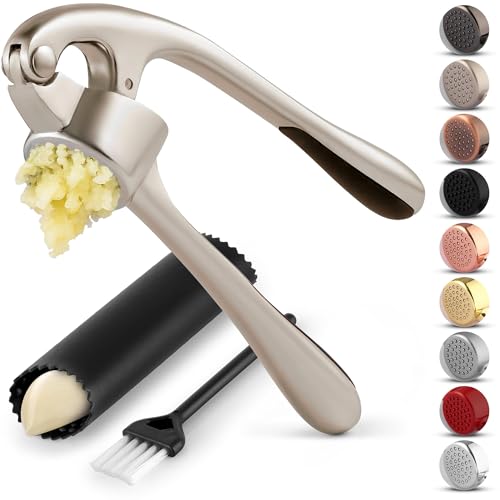
The best garlic press for arthritis is usually a rocker-style or ergonomic twist-action model that reduces hard squeezing and tight gripping.
Cooking at home is part of daily life for many people across the United States. From making pasta sauce in an American family kitchen to preparing roasted vegetables for dinner, fresh garlic adds great flavor. But crushing garlic can become a painful chore when arthritis affects the fingers, thumbs, or wrists. A standard garlic press often needs a firm grip and strong pressure. That can make a small kitchen task feel much harder than it should.
The good news is that you do not have to give up fresh garlic. Several kitchen tools use different motions to crush or chop garlic. A rocker-style crusher uses downward pressure from the palms, while a twist-action press spreads the work across both hands. A traditional press with wide, cushioned handles may also work well for someone who still has some grip strength. The right choice depends on which joints hurt and what kind of movement feels comfortable.
For many people with painful finger joints, a garlic rocker or rolling garlic chopper is a sensible place to start. The Joseph Joseph Garlic Rocker is one example of a design that avoids the usual squeezing motion. The Chef’n GarlicZoom is another option because it chops garlic through a rolling motion across a counter. Neither tool is a medical device, and neither is guaranteed to suit every type of arthritis. Comfort, control, and ease of cleaning should guide the final choice.
The best choice for many people with arthritis is a garlic tool that avoids strong finger squeezing. A rocker-style crusher is often a practical first choice because it uses pressure from the palms rather than a tight finger grip. You place the garlic under the curved tool and rock it across the clove. This can make the task easier for people who struggle to close their fingers around small handles.
A twist-action model is another useful option. These tools use two parts that turn toward each other to crush garlic. They may reduce the need for a strong pinch grip, although they still require hand movement and wrist control. Someone with painful wrists may find a rocker or rolling chopper more comfortable.
There is no single model that works best for every person with arthritis. Osteoarthritis, rheumatoid arthritis, and other joint conditions can affect different parts of the hand. One person may have trouble closing the fingers, while another may have pain at the base of the thumb or in the wrist. The best tool is the one that lets you prepare garlic with the least discomfort.
Source: katynel.com
Best starting point for painful finger joints
Try a rocker-style garlic crusher if you can place your palm on a tool more easily than you can squeeze narrow handles.
Best for reduced finger grip
Consider a twist-action design with broad contact areas, provided your wrists can turn without pain.
Best for people who dislike squeezing
Consider a rolling garlic chopper that works on a stable countertop.
Best for people with some remaining hand strength
Look for a traditional press with wide, soft, non-slip handles and an easy-open chamber.
Why a Standard Garlic Press Can Be Difficult
A standard garlic press has two handles joined by a hinge. You place a clove in the chamber and push the handles together. This movement can put pressure on the fingers, thumb, and wrist. It may be especially difficult when the press has short handles or a narrow grip.
Arthritis can cause pain, swelling, stiffness, and reduced hand strength. A movement that seems simple on a good day may become difficult during a flare. Repeating the same squeeze for several cloves can also lead to hand fatigue.
A garlic press should make food preparation easier, not turn dinner into a hand-strength test. If the tool needs more force than you can comfortably provide, choose another design.
Narrow handles
They may force the fingers into a tight grip and place more pressure on sore joints.
Strong hinge resistance
A stiff hinge can make each squeeze harder, especially when crushing large or unpeeled cloves.
Small cleaning parts
Tiny pins and removable pieces can be hard to hold and clean with stiff fingers.
Best Types of Garlic Presses for People With Arthritis
Garlic tools use different movements to break cloves into small pieces. This matters because arthritis does not affect every hand movement in the same way. A person who cannot squeeze firmly may still be able to press down with the palm. Another person may find that any twisting motion causes wrist pain.
Before buying a tool, think about the movement that hurts most. Do you struggle to close your fingers? Does your thumb hurt when it presses against your index finger? Does turning your wrist cause discomfort? Your answer can help narrow the choices.
Source: recipespalette.com
Rocker-style garlic press
A curved metal tool that crushes garlic when you rock it over the clove. It avoids the usual two-handle squeeze and is worth considering for people with weak finger grip.
Twist-action garlic press
A two-part tool that crushes garlic through a turning motion. It can reduce direct squeezing but may not suit people with painful wrists.
Traditional ergonomic garlic press
A hinged press with wide, padded handles. It can be comfortable for people who still have enough grip strength to operate it.
Rolling garlic chopper
A small countertop device that chops garlic as you roll it. It can reduce direct pressure on the fingers, although the rolling motion may still require some arm movement.
Rocker-Style Garlic Crushers
A rocker-style crusher is one of the most useful designs to consider when hand strength is limited. It often has a curved stainless steel surface with small holes. You place a peeled or prepared garlic clove on a cutting board, set the rocker over it, and press down while moving the tool back and forth.
The main benefit is the change in movement. Instead of closing two handles with your fingers, you can use the palm of your hand to apply pressure. This may be more comfortable when finger joints are sore. The tool also has fewer moving parts than many hinged presses.
The Joseph Joseph Garlic Rocker is a well-known example. Tom’s Guide lists this style as a suitable option for people with limited hand strength. EatingWell also notes that the rocker avoids a conventional squeezing motion. However, it produces a coarser mince than some traditional presses, and you must scrape the garlic from its surface.
A rocker is not automatically suitable for everyone. It still needs downward pressure, and pressing with the palm can be uncomfortable if the base of your thumb or wrist is painful. Try the movement gently before making it your regular kitchen tool.
Main advantage
It avoids the strong finger squeeze needed by many hinged presses.
Possible drawback
You may need to peel the garlic and scrape the minced pieces from the tool.
Good fit
People who can use their palms more comfortably than their fingers.
Twist-Action Garlic Presses
A twist-action press uses two connected or matching parts. You place garlic inside, bring the parts together, and turn them to crush the clove. The movement can spread pressure across both hands instead of concentrating it on a narrow handle.
The Joseph Joseph Helix Garlic Press is an example of this design. Tom’s Guide identifies it as an option for people with weak grip strength. Its handles work through a horizontal twisting motion, and its parts separate for cleaning. This design may be useful for someone who finds a standard press too hard to squeeze.
The main limitation is the turning motion. Twisting can place stress on the wrist and thumb. If you have arthritis in those areas, a rocker or rolling chopper may be a better option. A tool that reduces finger pressure but causes wrist pain is not a good trade.
Main advantage
It can reduce the need for a strong finger-closing motion.
Possible drawback
The turning action may be uncomfortable for people with wrist or thumb pain.
Good fit
People who have weak finger grip but can turn both hands comfortably.
Rolling Garlic Choppers
A rolling garlic chopper is an alternative to a traditional press. It uses a small enclosed chamber with cutting parts inside. You add peeled garlic, close the tool, and roll it across a flat surface to chop the clove.
The Chef’n GarlicZoom is a known example. EatingWell included it in its garlic tool testing and described the rolling action as easy for people with wrist or grip strength problems. The tool avoids the need to squeeze two handles together.
You should still check whether rolling feels comfortable. Some people may have difficulty pushing the device across a countertop. It also needs to be opened and cleaned after use, which can be a challenge if the parts are small.
Main advantage
It can reduce direct squeezing and strong finger pressure.
Possible drawback
It requires peeled garlic and may take extra work to clean.
Good fit
People who can roll a small tool more easily than they can operate a manual press.
Important Features to Look for When Buying a Garlic Press
The best garlic tool is not always the largest or most expensive one. A comfortable shape and simple operation matter more than extra features. Look for a design that fits your hand and does not require repeated hard movements.
The Arthritis Foundation recommends practical kitchen aids that reduce difficult hand movements. Its arthritis-friendly kitchen tool guide even highlights the Garlic Zoom as an alternative to squeezing garlic in a press. Mayo Clinic also explains that larger, cushioned handles can make kitchen tools easier to hold with less grip strength. These principles are useful when comparing garlic tools.
Source: oakandrowan.com
Wide handles or contact areas
Larger surfaces can spread pressure over more of the hand. They may be easier to use than thin metal handles.
Soft, non-slip material
Rubber or silicone grips can make a tool easier to hold without squeezing as hard.
Lightweight construction
A lighter tool can be easier to lift, position, and clean. However, it should still feel stable during use.
Simple operation
Choose a design with few steps and no small locking parts that require finger strength.
Easy cleaning
A wide-opening chamber, removable basket, or simple cleaning brush can reduce the work needed after cooking.
Stable countertop contact
A tool that stays in place can reduce the need to hold it tightly while using it.
Comfortable hand position
The tool should allow your wrist to stay in a natural position instead of bending sharply.
Why Handle Size Matters
Handle size can make a major difference when finger joints are painful. A narrow handle often requires the fingers to bend tightly around it. A wider handle gives the hand a larger surface to hold.
Look for rounded handles with a comfortable shape. They should not have sharp edges or hard ridges that press into sore areas. A soft covering may also improve comfort, especially when your hands feel stiff.
If you already own a useful press with thin handles, a suitable foam grip sleeve may make it easier to hold. However, the sleeve must stay secure and must not interfere with the hinge or the safe use of the tool.
Check the diameter
Choose a handle that feels comfortable without forcing your fingers into a tight bend.
Check the surface
A textured or cushioned grip may help prevent slipping.
Check the reach
The handles should open wide enough for you to place garlic inside without stretching your fingers.
Why Cleaning Should Affect Your Choice
Cleaning is easy to overlook when buying a garlic press. Yet removing sticky garlic pulp from tiny holes can be one of the hardest parts of the job for someone with arthritis.
Look for a press that opens widely or has a removable chamber. A built-in cleaning tool can help, but it should be easy to hold. A model that requires you to use a small pick with sore fingers may create more work than it saves.
Rinse the tool soon after use so garlic does not dry inside the holes. If the manufacturer allows dishwasher cleaning, check the care instructions for the exact model before placing it inside.
Wide-opening chamber
It gives you better access to leftover garlic and peel.
Simple cleaning brush
A larger brush handle may be easier to hold than a tiny cleaning pin.
Dishwasher compatibility
This can reduce hand washing, but confirm the manufacturer’s instructions.
How to Choose the Right Garlic Press for Your Type of Arthritis
Your symptoms should guide your purchase more than the product label. A tool advertised for weak hands may still be difficult if it uses a movement that hurts your particular joints. Think about which part of your hand does most of the work when you crush garlic.
For example, a person with painful finger joints may prefer a rocker. Someone with thumb pain may dislike a press that needs a strong pinch. A person with wrist stiffness may find a twisting device uncomfortable even if it needs less finger strength.
The following guide is a starting point, not a medical rule. Arthritis can affect each person differently, and more than one joint may be involved.
Source: nymag.com
Finger joint pain
Consider a rocker or rolling chopper if closing your fingers around handles is uncomfortable.
Thumb base pain
Avoid tools that need a strong pinch or concentrated thumb pressure. Look for broad palm contact.
Wrist pain
Be cautious with twist-action models. A tool that uses a gentle downward movement may feel better, depending on your symptoms.
Weak grip strength
Look for a rolling chopper or a rocker that does not depend on closing two handles.
Finger stiffness
Choose a tool that is easy to load and unload without needing to spread your fingers widely.
Pain in several hand joints
Try a countertop chopper or ask an occupational therapist about suitable adaptive kitchen equipment.
If You Have Osteoarthritis in Your Hands
Hand osteoarthritis can affect the joints near the fingertips, middle finger joints, and base of the thumb. These areas may become painful during gripping, pinching, and repeated squeezing.
A wide-grip tool may help if the main problem is holding a narrow handle. A rocker may also be worth trying because it changes the way pressure is applied. If pressing with the palm hurts the base of your thumb, choose another method.
The goal is to avoid forcing a painful joint through a movement. A comfortable kitchen tool should let you prepare food without making your hand work harder than necessary.
Try
A palm-operated rocker or rolling garlic chopper.
Be careful with
Narrow handles and stiff hinges that require repeated squeezing.
If You Have Rheumatoid Arthritis
Rheumatoid arthritis can cause joint pain, swelling, and stiffness. Symptoms may change from day to day, so a tool that feels comfortable one morning may be difficult during a flare.
A lightweight tool with a simple movement can reduce the work involved in preparing garlic. It may also help to prepare smaller amounts and take breaks instead of crushing many cloves at once.
During a painful flare, do not force your hands to use a manual press. Pre-minced garlic, frozen garlic portions, or a food chopper may be more practical until your hands feel better.
Try
A low-effort chopper with simple parts and easy cleaning.
Be careful with
Repeated squeezing, strong twisting, and tools with small parts.
Garlic Press Styles Compared for Arthritis
Comparing the main designs side by side makes it easier to see which tool may suit your needs. The most important difference is the movement each design requires. A traditional press needs a closing grip, a rocker uses downward pressure, and a rolling chopper uses movement across a counter.
The table below gives a practical comparison. The comfort descriptions are design-based guidance, not results from a medical trial or a controlled test of every product.
Source: greenchoicelifestyle.com
Rocker
Best starting point when squeezing is the main problem and palm pressure is comfortable.
Twist-action
Worth considering when finger grip is weak but wrist rotation is comfortable.
Traditional ergonomic press
Suitable when you can still squeeze gently and want a familiar press design.
Rolling chopper
A useful alternative when direct squeezing is difficult and rolling is comfortable.
Which Garlic Tool Should You Choose?
If your main issue is weak finger grip, begin by comparing a rocker and a rolling chopper. Both avoid the standard handle-closing movement. If your wrists hurt when turning, do not assume that a twist-action model will be easier simply because it has an ergonomic label.
If you can squeeze gently, a wide-handled traditional press may still be the most practical option. It can produce a fine mince and may work with unpeeled cloves, depending on the design. Check how easily its basket opens before buying.
For less finger squeezing
Rocker or rolling chopper.
For reduced grip pressure
Twist-action design, if wrist movement is comfortable.
For fine minced garlic
A well-designed traditional press with wide, comfortable handles.
For simple cleanup
A model with an accessible chamber and few small parts.
How to Use a Garlic Press Without Putting Too Much Stress on Your Hands
Using a suitable tool in the right way can make garlic preparation easier. Even an ergonomic press can cause discomfort if you use too much force or work for too long. Set up your kitchen before you start and keep the task simple.
A stable cutting board, comfortable working height, and easy access to ingredients can reduce unnecessary movements. If standing for long periods is tiring, sit at a suitable counter or table while preparing food.
Source: katynel.com
Prepare your workspace
Place a stable cutting board on a flat surface. Keep the garlic and tool within easy reach.
Use a small amount first
Start with one clove to check how the tool feels.
Use a comfortable hand position
Keep your wrist as straight and relaxed as possible.
Avoid forcing the tool
If the garlic does not crush with comfortable pressure, stop and adjust the clove or use another method.
Take breaks
Do not process a large amount of garlic in one long session if your hands become tired.
Clean the tool promptly
Rinse away garlic residue before it dries and becomes harder to remove.
Step-by-Step Guide for a Rocker-Style Crusher
A rocker is simple to use, but a few small changes can make the process more comfortable. Follow the instructions supplied with your model, since shapes and cleaning methods can differ.
First, place a peeled garlic clove on a stable cutting board. Position the curved part of the rocker over the clove. Rest your palm on the top surface and use a gentle rocking movement to crush the garlic.
Move the tool back and forth until the garlic reaches the texture you want. Avoid pushing hard with your fingertips. When finished, lift the rocker and scrape the garlic into your dish with a suitable spoon or spatula.
If you feel pain while pressing, stop. Do not lean your full body weight onto the tool to force the garlic through. A rolling chopper or prepared garlic may be a better choice.
What you need
A rocker crusher, garlic cloves, a stable cutting board, and a spoon or spatula.
Sign of success
The garlic breaks into pieces with a comfortable movement and without sharp pain.
If it does not work
Check the position of the clove and try a smaller piece. Do not increase pressure if your hand hurts.
Step-by-Step Guide for a Traditional Garlic Press
If you choose a traditional press, begin with a clean, dry tool. Open the chamber and place one clove inside. Some presses can handle unpeeled cloves, but others work better when the skin is removed.
Close the handles slowly. Use only the pressure that feels comfortable. If the press has wide handles, place your fingers across the grip rather than forcing them into a tight position.
Open the press and remove the minced garlic with a spoon. If the clove is too large or the press feels difficult to close, remove it and cut it into a smaller piece with an appropriate kitchen tool. Never force the handles together.
What you need
A wide-handled garlic press, one garlic clove, and a spoon.
Sign of success
The garlic passes through the holes without excessive hand pressure.
If it does not work
Check for a blocked chamber, reduce the clove size, or switch to a less demanding tool.
Common Mistakes to Avoid When Buying a Garlic Press for Arthritis
A tool can look comfortable in a product photo but feel very different in your hand. Avoid buying a garlic press based only on its shape, material, or advertising claims. Think about the actual movements required to load, operate, empty, and clean it.
A few common mistakes can lead to wasted money or more hand discomfort. Check the full design before making a purchase.
Source: kitchengearexpert.com
Choosing a press with narrow handles
Thin handles can require a tighter grip. Look for wide contact areas that fit your hand.
Ignoring wrist movement
A twist-action model may reduce finger squeezing but still cause wrist discomfort.
Buying a heavy tool without checking its weight
Heavy stainless steel can feel durable, but it may be tiring to lift and position.
Ignoring the cleaning process
A press with tiny removable parts can be difficult to clean when fingers are stiff.
Assuming every rocker is effortless
A rocker still needs downward pressure. It may not suit people with painful palms or thumb joints.
Using too many cloves at once
Overfilling the chamber can make pressing harder and cause garlic to spill around the tool.
Believing marketing claims without checking the design
Words such as ergonomic and arthritis-friendly do not prove that a tool will work comfortably for your hands.
Do Not Confuse Durability With Comfort
Stainless steel is a common material for garlic presses. It can resist corrosion and handle regular kitchen use when properly made and maintained. However, a strong metal body does not guarantee that the handles are comfortable.
Some heavy presses need less effort to crush garlic because their construction provides useful leverage. Others may be tiring to lift or hold. Consider the whole design rather than choosing a tool based on material alone.
If possible, hold the press before buying it. Check whether your hand can reach the handles comfortably and whether the hinge moves without excessive force.
Look for
Smooth edges, a comfortable grip, stable construction, and an easy-moving hinge.
Avoid
Sharp edges, uncomfortable handle gaps, loose parts, and mechanisms that require excessive force.
Alternatives to a Garlic Press When Arthritis Makes Cooking Difficult
You do not need a manual garlic press to enjoy fresh garlic. If every press style causes discomfort, use a method that asks less of your hands. There is no reason to keep using a tool that makes cooking painful.
Several alternatives can help you add garlic to meals. Some require a little preparation, while others are ready to use straight from the package.
Source: bestproducts.com
Pre-minced garlic
Refrigerated or jarred minced garlic is convenient because it requires no crushing or chopping. Check the ingredient list and storage instructions.
Frozen minced garlic
Frozen garlic cubes or portions can save time and reduce repetitive hand movements. Follow the package instructions for storage and use.
Electric food chopper
A small electric chopper can process garlic with less direct hand effort. Choose one with simple controls and an easy-to-remove bowl.
Food processor
A food processor can chop several cloves at once. It may be useful when preparing meals in larger batches.
Knife and prepared garlic
If you can safely use a knife, pre-peeled cloves and a stable cutting board may reduce preparation time. Do not use a knife if hand control or grip is unreliable.
Garlic paste
Ready-made garlic paste can be a convenient option for sauces, marinades, and cooked dishes.
Is an Electric Garlic Chopper Better for Arthritis?
An electric garlic chopper may be a better option when manual tools cause pain. It uses a motor to chop the garlic, so you do not need to crush cloves by squeezing handles. You usually place the garlic inside, close the lid, and press a button.
However, electric models have their own drawbacks. Some have heavy bowls, tight lids, small buttons, or parts that are difficult to remove. A lightweight model with simple controls and dishwasher-safe removable parts may be easier to manage.
If you have difficulty lifting kitchen equipment, choose a compact model that can stay on the counter. Check whether the bowl can be emptied without a strong grip.
Choose simple controls
Large, easy-to-press buttons may be more comfortable than small switches.
Check the lid
Avoid a design that needs a strong twisting motion to lock or unlock.
Check cleaning needs
Removable parts should be easy to hold, wash, and put back together.
Is Pre-Minced Garlic a Good Option?
Yes. Pre-minced garlic is a practical choice when hand pain makes fresh preparation difficult. It can be added to many cooked dishes without peeling or crushing cloves.
Jarred garlic may have a different flavor and texture from freshly crushed garlic. Some products also contain water, salt, or other ingredients. Check the label if you need to manage sodium or avoid certain ingredients.
Frozen garlic portions are another useful choice. You can take out the amount you need and return the rest to the freezer according to the package directions.
For quick meals
Keep a small jar of minced garlic in the refrigerator according to its label.
For portion control
Use frozen garlic portions so you do not need to prepare fresh cloves each time.
For less hand effort
Use garlic paste or ready-minced garlic when manual preparation is uncomfortable.
How to Keep Your Garlic Press Clean and Easy to Use
A clean garlic press is easier to use and helps prevent old food residue from building up. Garlic can become sticky as it dries, making small holes and moving parts harder to clean. Cleaning the tool soon after cooking can save effort later.
The best cleaning method depends on the material and design. Always follow the manufacturer’s care instructions, especially for models with plastic, silicone, or removable components.
Source: walmart.com
Rinse soon after use
Run the chamber under warm water before the garlic dries.
Use a soft brush
A suitable brush can remove garlic from small holes without requiring your fingertips to pick at the residue.
Open removable parts
Separate the chamber if the manufacturer designed it to come apart for cleaning.
Use mild dish soap
Wash food-contact surfaces with dish soap and warm water unless the care instructions specify another method.
Dry the tool fully
Dry metal parts before storing them to help prevent unwanted moisture and corrosion.
Make Cleaning Easier With Less Hand Movement
Cleaning can be harder than crushing garlic for some people with arthritis. Instead of holding a small press in one hand and scraping it with the other, place it securely in the sink or on a stable surface. Use a long-handled cleaning brush if that is more comfortable.
If the press has a removable basket, check whether it can be opened without a tight pinch. Avoid small cleaning pins if they are difficult to hold or control. A dishwasher-safe model may help, but only use that option when the manufacturer allows it.
Do not store a wet garlic press in a closed drawer. Let it dry fully before putting it away. Keeping the tool in an easy-to-reach place can also reduce unnecessary handling.
Use a larger brush handle
It may be easier to hold than a tiny cleaning pick.
Keep the press accessible
Store it in a convenient drawer or countertop holder rather than a hard-to-reach cabinet.
Choose fewer parts
Simple designs can reduce the number of items you need to handle and clean.
What the Research and Product Guides Tell Us
The available guidance supports choosing kitchen tools that reduce tight gripping, repeated squeezing, and uncomfortable wrist movements. However, it does not establish that one garlic press is medically best for every person with arthritis.
The Arthritis Foundation’s guide to arthritis-friendly kitchen tools recommends the Garlic Zoom as a way to chop garlic without squeezing a traditional press. Mayo Clinic’s joint protection guidance recommends larger, cushioned handles because they can reduce the grip strength needed for everyday tools.
Tom’s Guide compared several garlic presses and identified the Joseph Joseph Helix as an option for weak grip strength. Its review describes the two-hand twisting action and the way the tool separates for cleaning. EatingWell tested 15 garlic tools and discussed the differences between traditional presses, rockers, twist designs, and rolling choppers.
America’s Test Kitchen also evaluated garlic presses for factors such as pressing effort, handle comfort, and cleaning. Its testing notes that even well-performing traditional presses still require some pressure. These findings matter because a product that makes good minced garlic may not be comfortable for someone with painful joints.
The strongest practical conclusion is to match the tool’s movement to your symptoms. Product testing can help explain how a model works, but it cannot predict how comfortable that model will feel in your hands.
Documented arthritis guidance
The Arthritis Foundation recommends adaptive kitchen tools and highlights a rolling garlic chopper as an alternative to squeezing.
Documented joint protection advice
Mayo Clinic recommends larger, cushioned handles for kitchen tools when grip strength is limited.
Reported product testing
Tom’s Guide and EatingWell discuss specific designs and their operation, including rocker and twist-action models.
Important limitation
There is no established universal ranking of garlic presses based on comfort for every type of arthritis.
A Practical Next-Question Gap Map
General garlic press buying guides often focus on crushing quality, material, capacity, and price. Those details matter, but people with arthritis also need to know which movements a tool requires and whether cleaning will create another hand-related problem.
The following questions extend the main buying decision. The observations below reflect the product and guidance pages reviewed for this article, not a claim that every website has been checked.
Which garlic tool avoids strong squeezing?
Reader stage: Before buying. Basis: Inferred next need from arthritis-related hand limitations. Reviewed coverage: ANSWERED by arthritis guidance and product comparisons. Benefit: Helps readers compare rocker and rolling designs. Priority: High.
Can a twist-action press hurt an arthritic wrist?
Reader stage: Before buying. Basis: Inferred from the movement used by twist designs. Reviewed coverage: SHALLOW in general product comparisons. Benefit: Prevents readers from choosing a tool that trades finger strain for wrist strain. Priority: High.
How easy is a garlic press to clean with stiff fingers?
Reader stage: After use. Basis: Inferred from the small holes and removable parts in common designs. Reviewed coverage: ANSWERED in part by product testing. Benefit: Helps readers compare accessible chambers and simple cleaning systems. Priority: Medium.
Is an electric chopper easier than a manual press?
Reader stage: Alternative purchase. Basis: Inferred from the need to reduce manual force. Reviewed coverage: SHALLOW in traditional press comparisons. Benefit: Gives readers another option when all manual designs cause discomfort. Priority: High.
What should you do when every press causes hand pain?
Reader stage: During use. Basis: Inferred from individual differences in arthritis symptoms. Reviewed coverage: SHALLOW in ordinary buying guides. Benefit: Explains when to stop and choose prepared garlic or seek adaptive equipment advice. Priority: High.
Frequently Asked Questions
Q
What is the best garlic press for arthritis in the hands?
A rocker-style garlic crusher is a good starting point for many people with arthritis because it avoids the usual finger-squeezing motion. The Joseph Joseph Garlic Rocker is one example. However, a rolling garlic chopper may be better if palm pressure also causes discomfort.
Choose a tool based on the movement your hands can perform comfortably. No single model is best for everyone.
Q
Is a garlic rocker better than a traditional garlic press for arthritis?
A garlic rocker may be easier because it uses a downward rocking motion instead of closing two handles together. This can reduce the need for a tight finger grip.
A traditional press may still work well if it has wide, cushioned handles and you have enough grip strength. The rocker is not automatically better if pressing with your palm hurts.
Q
Is the Joseph Joseph Helix garlic press good for weak hands?
The Joseph Joseph Helix is worth considering if squeezing a traditional press is difficult. Its twist-action design uses both hands and changes the direction of the effort.
Tom’s Guide identified it as an option for people with weak grip strength. However, the twisting movement may not suit someone with wrist or thumb arthritis.
Q
Can I use a garlic press without peeling the garlic?
Many traditional garlic presses can handle unpeeled cloves, but this depends on the model. The press pushes the garlic through its holes while much of the papery skin remains in the chamber.
Rockers, rolling choppers, and some twist-style tools may require peeled cloves. Check the product instructions before use.
Q
Are electric garlic choppers better for people with arthritis?
An electric garlic chopper can be a good alternative because the motor does the chopping instead of your hands. It may reduce the effort needed to crush or mince several cloves.
Choose a lightweight model with simple controls, an easy-to-open lid, and removable parts that are comfortable to clean. Check that you can safely lift and empty the bowl.
Q
What is the easiest way to crush garlic with weak hands?
A rolling garlic chopper or rocker-style crusher may be easier than a traditional press. Both change the movement needed to prepare garlic and can reduce the need for strong finger squeezing.
If these tools still cause discomfort, use jarred minced garlic, frozen garlic portions, or prepared garlic paste.
Q
What handle material is best for an arthritis-friendly garlic press?
Soft rubber or silicone grips can improve comfort and help prevent slipping. Wide handles are often more useful than thin metal handles because they provide a larger contact area.
The shape and size matter as much as the material. Choose a grip that fits your hand without forcing your fingers into a tight position.
Q
Should I stop using a garlic press if my hands hurt?
Yes, stop if the tool causes sharp pain, increased swelling, or discomfort that continues after use. Do not force a press or try to overcome resistance by leaning your body weight onto it.
Use prepared garlic or another method that feels comfortable. If kitchen tasks regularly cause pain or interfere with daily activities, an occupational therapist can help you find suitable adaptive tools and joint protection methods.
✦ Wrapping Up
Conclusion
Finding the right garlic press can make cooking more comfortable when arthritis affects your hands. For many people, a rocker-style crusher is a sensible first choice because it avoids the strong squeezing motion used by traditional presses. The Joseph Joseph Garlic Rocker is one example worth considering. A rolling chopper such as the Chef’n GarlicZoom is another option when you want to reduce direct finger pressure.
If your fingers have weak grip strength but your wrists move comfortably, a twist-action model such as the Joseph Joseph Helix may be a good fit. If you still have some hand strength, a traditional press with wide, cushioned handles can also work. Focus on comfort, easy cleaning, stable operation, and the amount of pressure needed.
Remember that arthritis affects people differently. A tool that feels easy for one person may cause pain for another. Test a new tool with one clove, use gentle movements, and stop if discomfort develops. If manual garlic preparation remains difficult, an electric chopper or ready-minced garlic can help you keep enjoying home-cooked meals without unnecessary hand strain.
💡 Key Takeaway
Start by comparing a rocker-style crusher with a rolling garlic chopper. Choose the one that feels comfortable with a single clove, requires no painful squeezing or twisting, and is easy to clean. If both cause discomfort, switch to prepared garlic or ask an occupational therapist about adaptive kitchen tools.