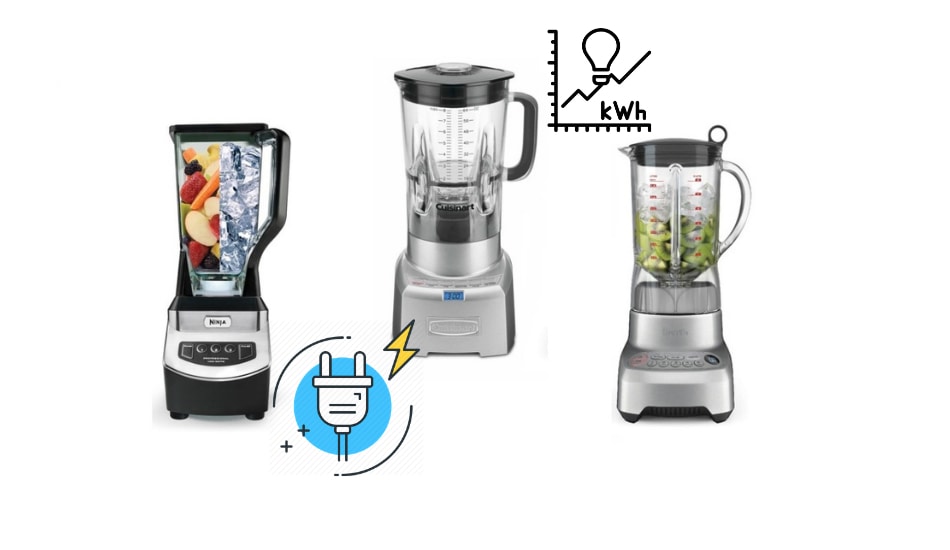
Most household blenders use about 300 to 1,500 watts while running, but their short use time often keeps electricity costs low.
In American homes, a blender may help make a breakfast smoothie, crush ice for a summer drink, blend soup, or prepare a quick sauce for dinner. These jobs use electricity, but a blender usually runs for only a few seconds or minutes at a time. That short run time matters just as much as the wattage printed on the appliance.
A blender rated at 1,000 watts does not use 1,000 watts of energy every hour it sits on your kitchen counter. It draws power when it runs, and the energy used depends on the length of each session. To estimate the cost, you need the blender’s wattage, its total running time, and your electricity rate in dollars per kilowatt-hour.
For example, a hypothetical 1,000-watt blender running for five minutes uses about 0.083 kilowatt-hours of energy. At an electricity rate of 16 cents per kilowatt-hour, that session costs about 1.3 cents. Your actual result may differ because the motor’s real power draw changes with the load, speed, and design.
A blender’s electricity use depends on its power rating and how long the motor runs. Small personal blenders often have lower rated power than large countertop models, while some high-power blenders are designed for tough ingredients such as ice, nuts, and fibrous produce. The rating on the label is a useful starting point, not a guarantee of the exact power drawn during every task.
For a quick estimate, consider a range of 300 to 1,500 watts. A 300-watt blender running for one minute uses about 0.005 kilowatt-hours if it draws 300 watts throughout that minute. A 1,500-watt blender running for the same minute uses about 0.025 kilowatt-hours under the same assumption.
These figures are calculations, not measurements of specific blender models. Real energy use can be lower or higher than a simple estimate based on the rated wattage, depending on the motor, load, speed setting, and operating pattern. A blender that pulses for a few seconds may use less energy than one that runs continuously for a full minute.
Source: thehomehacksdiy.com
Small personal blender
A compact unit may be rated around 300 to 600 watts. Its actual electricity use depends on its label rating and how long it blends.
Standard countertop blender
Many everyday models fall around 500 to 1,000 watts, though product designs vary. Smoothies, sauces, and soft ingredients may need only brief operation.
High-power blender
Some models are rated around 1,000 to 1,500 watts or more. They may be built for demanding tasks, but a higher rating does not automatically mean higher energy use for every recipe.
Does a Blender Use Electricity When It Is Off?
A basic blender with a mechanical switch may use no meaningful electricity while switched off and unplugged. A model with electronic controls, a display, or standby features may draw a small amount while connected to power, depending on its design.
If you want to reduce standby use, switch the blender off and unplug it when practical, especially if the manual recommends doing so. Never pull the plug with wet hands or handle a cord near a wet counter.
Mechanical controls
These may have little or no standby draw, but the exact result depends on the circuit design.
Electronic controls
A display or touch panel may need standby power. Check the product documentation or measure the draw with a suitable energy meter.
Watts, Kilowatts, and Kilowatt-Hours Explained
To work out a blender’s energy use, you need to know the difference between watts and kilowatt-hours. Watts describe the rate at which an appliance uses power at a given moment. A kilowatt is 1,000 watts, so a 750-watt blender has a rated power of 0.75 kilowatts.
A kilowatt-hour, often written as kWh, measures energy used over time. An appliance that draws 1 kilowatt for one hour uses 1 kWh. If it draws 1 kilowatt for only six minutes, it uses 0.1 kWh, assuming its power draw stays constant.
This distinction explains why a blender with a high wattage can still have a low running cost. A blender does not normally run all day like a refrigerator. Even if it draws substantial power during blending, the short operating time limits its total energy use.
Source: thehomehacksdiy.com
Watts (W)
A measure of power. Use the appliance label as the starting point for an estimate.
Kilowatts (kW)
Power in thousands of watts. Divide watts by 1,000 to convert them to kilowatts.
Kilowatt-hours (kWh)
A measure of energy used over time. Electricity bills commonly show energy use in kWh.
The Formula for Blender Electricity Use
Use this formula to estimate the electricity consumed during a blending session: kilowatt-hours = watts ÷ 1,000 × hours of use. Convert minutes to hours by dividing the number of minutes by 60.
For example, a 600-watt blender running for three minutes uses an estimated 0.03 kWh. The calculation is 600 ÷ 1,000 × 3 ÷ 60 = 0.03 kWh. This assumes a steady 600-watt draw during those three minutes.
Step 1
Find the blender’s rated wattage on its label or in its manual.
Step 2
Record the total time the motor runs, excluding time spent preparing ingredients.
Step 3
Convert the wattage to kilowatts and the run time to hours.
Step 4
Multiply the kilowatts by the hours to estimate energy use in kWh.
How Much Does It Cost to Run a Blender?
The cost to run a blender depends on the electricity rate where you live and the amount of energy the blender uses. In the United States, residential electricity rates vary by state, utility, and plan. Your own electric bill is the best starting point for a realistic calculation.
To estimate the cost, multiply the energy used in kWh by your electricity price per kWh. If a blender uses 0.05 kWh and your rate is 16 cents per kWh, the session costs 0.8 cents. That is less than one cent, based on the stated assumptions.
The examples below use a hypothetical rate of $0.16 per kWh. This is an illustration, not a claim about the current average rate in every part of the United States. Replace it with your actual rate to estimate your own cost.
Source: cornwallsolarcompany.com
Cost formula
Electricity cost = energy used in kWh × price per kWh.
Example
A session using 0.083 kWh at $0.16 per kWh costs about $0.013, or 1.3 cents.
Monthly cost
Multiply the estimated cost per session by the number of sessions you use each month.
Example Costs for Different Blender Wattages
This table compares estimated energy use for a five-minute session at three rated power levels. It assumes that each blender draws its full rated wattage throughout the session and uses an illustrative electricity rate of $0.16 per kWh.
Actual use may differ. The table helps show how wattage and run time affect a bill, but it does not establish that one blender is more efficient than another.
300-watt blender
Five minutes of use equals about 0.025 kWh and costs about 0.4 cents at the example rate.
750-watt blender
Five minutes of use equals about 0.0625 kWh and costs about 1 cent at the example rate.
1,500-watt blender
Five minutes of use equals about 0.125 kWh and costs about 2 cents at the example rate.
Daily and Monthly Blender Costs
A blender used for five minutes each day runs for about 150 minutes, or 2.5 hours, in a 30-day month. If it draws 750 watts for that entire time, estimated monthly energy use is 1.875 kWh.
At the illustrative rate of $0.16 per kWh, that equals $0.30 per month. If you use the blender for only two minutes per day, the estimated cost will be lower. If you blend several batches for longer periods, your cost will rise with the added running time and power draw.
Occasional use
A few short sessions each week generally result in a low total energy cost.
Daily smoothies
Estimate the motor’s total daily running time, then multiply by the number of days you blend each month.
Frequent batch preparation
Longer sessions can use more electricity, so measuring actual consumption may be useful if you blend large amounts often.
What Affects a Blender’s Electricity Use?
A blender’s wattage is only one part of the picture. The amount of food in the jar, the texture of the ingredients, the selected speed, and the time spent blending can all affect how much electricity the appliance uses.
A soft banana smoothie may blend quickly, while frozen fruit or ice may require more work. A suitable high-power model may handle a tough load faster, but that does not mean every recipe will use less energy in that model. The total depends on both power draw and run time.
The most useful comparison is energy used for the same task, with a similar ingredient amount and desired result. A wattage label alone cannot tell you how much energy a blender will consume for a particular recipe.
Source: cornwallsolarcompany.com
Motor rating
A higher rated wattage indicates a higher stated power level, but does not reveal the exact draw during every blending task.
Ingredient texture
Hard, frozen, or fibrous ingredients may require a different speed, more blending time, or a suitable liquid amount.
Batch size
A very large or very small load can affect blending behavior. Follow the minimum and maximum fill limits in the manual.
Blending time
Longer motor run time generally increases energy use when the power draw is similar.
Pulse settings
Short bursts can reduce the time the motor runs, but repeated pulses may add up. Use the setting that achieves the needed result.
Motor and blade design
Design affects how well the blender processes a given load. Do not assume that a particular design is more energy-efficient without comparable measurements.
Does Ice Crushing Use More Electricity?
Crushing ice can place a heavier load on a blender than mixing soft fruit. Depending on the model, the motor may draw more power, run for longer, or use short pulses to break up the cubes.
Use only the type and amount of ice permitted by the manufacturer. Some blenders require liquid or a particular loading method, while others have a dedicated ice-crushing setting. Do not keep running a stalled motor in an attempt to force the blades through a jam.
Use the correct setting
Choose the recommended pulse or ice-crush mode if the model provides one.
Check the load
Stay within the jar’s capacity and follow instructions for frozen ingredients.
Stop if the motor stalls
Switch off and unplug the blender before checking for a jam. Never put fingers or utensils into a moving blade assembly.
Does a Higher-Wattage Blender Use More Electricity?
A higher-wattage blender can use more electricity per minute if it actually draws more power. However, it may complete a task in less time, so the total energy used can be closer than the wattage ratings suggest.
For example, a hypothetical 1,200-watt blender running for 30 seconds uses 0.01 kWh if it draws 1,200 watts throughout the session. A 600-watt blender running for two minutes uses 0.02 kWh under the same steady-draw assumption. In this example, the higher-power unit uses less energy because it runs for much less time.
This is a mathematical comparison, not a measured result for actual products. When choosing a blender, consider the foods you make, the time required, the jar size, and the manufacturer’s instructions rather than using wattage as the only measure of efficiency.
Choose for your main tasks
A compact model may suit soft fruit and small servings, while frequent ice crushing or dense mixtures may call for a model designed for those jobs.
Compare like with like
Use the same recipe, ingredient weight, starting temperature, and target texture when comparing energy measurements.
How to Measure Your Blender’s Actual Electricity Use
A plug-in energy meter can provide a more useful estimate than a wattage label alone. The meter measures the electricity drawn by an appliance over a set period, which can account for changes in power during a real blending session.
Before using a meter, check that it is designed for the voltage, plug type, and electrical load of your blender. Do not use a damaged meter, an overloaded outlet, or a device that is not rated for the appliance. If your blender’s instructions prohibit a particular setup, follow the instructions instead.
A meter reading is most useful when you measure a normal recipe and record the run time. Repeat the measurement if the task varies a lot, and treat a single reading as an example rather than a universal figure for the model.
Source: kitchenwink.com
What you need
A suitable plug-in energy meter, your blender, a normal recipe, and your electricity rate from your bill.
What to record
The energy reading in kWh, the blending time, the recipe or load, and the rate used for the cost calculation.
What the result means
The measured result applies to that test under those conditions. Other recipes and settings may use different amounts of electricity.
Step-by-Step Measurement Method
First, read the meter’s instructions and confirm that the meter is suitable for your blender. Place it in the approved setup with dry hands and a dry work area, then connect the blender according to the meter instructions.
Prepare the ingredients and blend as you normally would. Do not change the recipe simply to force a lower reading, and never leave the blender unattended if its instructions require supervision. When the session ends, use the meter’s accumulated energy reading if it provides one.
Multiply the measured kWh by your electricity rate to estimate the energy charge for that session. If the meter shows only watts or instant power, it may not provide enough information by itself to calculate the full session’s energy without recording the changing draw over time.
Step 1: Check the equipment
Confirm the meter’s rating and inspect the plug, cord, and outlet for damage.
Step 2: Measure a normal session
Use your usual ingredients, settings, and blending time.
Step 3: Read the energy total
Record the kWh reading after blending, if the meter supports accumulated energy measurement.
Step 4: Calculate the cost
Multiply the measured kWh by the rate shown on your electricity bill.
Step 5: Repeat when useful
Measure another normal session if recipes differ, then compare results under similar conditions.
What If the Meter Reading Seems Too High?
Check the units first. A display showing watts is not the same as one showing watt-hours or kilowatt-hours. Also confirm that the meter’s energy total was reset before the test and that it did not include other appliances.
Next, compare the measured time with the actual time the motor ran. If the reading still seems unusual, check the blender manual and meter instructions. Stop using the appliance and seek qualified service if you notice a burning smell, damaged wiring, sparks, or unusual overheating.
Possible unit mix-up
Confusing W, Wh, and kWh can produce a large calculation error.
Other devices included
A meter that measures more than the blender will report combined use.
Unexpected appliance behavior
Unusual heat, smoke, sparks, or a damaged cord calls for stopping use, not further testing.
Simple Ways to Reduce Blender Electricity Use
The easiest way to reduce blender energy use is to avoid unnecessary run time while still following the manufacturer’s directions. Most households do not need to worry about a few seconds of blending, but better habits can help when you use the appliance often.
Start by preparing ingredients before turning on the blender. Cut large pieces to the size recommended in the manual, add the required liquid, and use the correct speed or pulse setting. This can help the blender reach the desired texture without repeated, unneeded runs.
Do not reduce blending time so much that the recipe remains unfinished, and do not overload the jar to save time. The aim is to use the appliance correctly, not to force the motor to work under conditions it was not designed to handle.
Source: reviewmast.com
Prepare ingredients first
Have fruit, vegetables, liquid, and other ingredients ready before starting the motor.
Use the right batch size
Follow the jar’s fill limits. A suitable load can help the blades move ingredients as intended.
Choose an appropriate setting
Use the speed or pulse mode recommended for the task instead of repeatedly changing settings without need.
Avoid needless extra cycles
Check the texture between cycles and stop once the recipe reaches the desired result.
Maintain the appliance
Clean the jar and blade assembly as directed, and address damage or abnormal operation rather than continuing to use a faulty blender.
Unplug when practical
If the appliance has electronic standby features, unplugging it after use may avoid standby draw. Follow the manual and handle the plug safely.
Is It Cheaper to Blend One Large Batch or Several Small Batches?
One larger batch may use less energy than several separate batches if it reduces the total time the motor runs. However, the jar must stay within its permitted capacity, and the ingredients must blend properly.
Several small batches may be better when a large load would exceed the fill line or prevent the blades from moving ingredients as intended. Compare the total motor run time for the full amount of food rather than looking only at the time for one batch.
Use one batch when suitable
A single batch can save repeated setup and blending time when the recipe fits the jar and the manual permits it.
Split loads when needed
Use smaller batches if required for safe operation, proper circulation, or the desired texture.
Blender Electricity Use Compared With Other Kitchen Appliances
A blender’s rated power can look high beside some small kitchen devices, but power ratings alone do not show which appliance uses the most energy over a day. Run time matters. A high-power appliance used for seconds can consume less energy than a lower-power appliance that runs for much longer.
For example, a hypothetical 1,000-watt blender used for three minutes consumes 0.05 kWh if it draws its rated power for the full session. A hypothetical 100-watt device running for one hour consumes 0.1 kWh under the same steady-draw assumption. The blender has the higher wattage, yet the longer-running device uses twice as much energy in this example.
This is why a fair comparison needs both power and time. Appliances also cycle on and off, and their actual draw may vary, so the figures below are examples for understanding the calculation rather than measured values for specific products.
Source: thehomehacksdiy.com
Blender
Often runs for seconds or minutes at a time. Short use sessions can keep total energy consumption low.
Microwave
May draw substantial power while heating, but the energy for a task depends on cooking time and actual power draw.
Coffee maker
Energy use depends on brew time, heating cycles, and whether the machine keeps coffee warm.
Refrigerator
It cycles through the day, so its total daily energy use cannot be judged from a single wattage value alone.
Electric oven
A cooking session can last much longer than a blender session, making total run time important to the comparison.
Should You Worry About a Blender Raising Your Electric Bill?
For most homes, a blender used for a few minutes a day is unlikely to be a major part of the electricity bill. The cost depends on the model, the total time it runs, and the local electricity rate, but short sessions generally use modest amounts of energy.
If you are trying to cut household electricity costs, it is usually more useful to measure appliances that run for long periods or draw power for heating, cooling, or continuous operation. A blender can still be included in an energy audit, especially if it is used for long periods each day, but its impact should be assessed using actual use rather than assumptions.
Estimate before replacing
Calculate or measure your current blender’s energy use before buying a new one just to save electricity.
Check the full cost
Consider purchase price, expected use, suitable capacity, and performance for your recipes instead of relying on wattage alone.
Common Mistakes When Estimating Blender Power Use
The most common mistake is treating the wattage on a blender’s label as the energy used during a full hour. Wattage is a rate of power use, so it must be multiplied by the time the appliance runs to estimate energy consumption.
Another mistake is assuming that the motor draws exactly the rated wattage throughout every session. A label rating is useful for an estimate, but actual power can change with the operating mode and load. For a precise result, use a suitable meter and record the energy for the task you want to understand.
It is also easy to overstate the cost by using an electricity rate that does not match your bill. Some bills include different charges, fixed fees, or time-based rates. For the basic appliance estimate, use the applicable price per kWh and remember that the result is an estimate of energy cost, not the whole bill.
Source: storage.googleapis.com
Mistake: multiplying watts by one hour automatically
Use the actual run time. A 1,000-watt blender running for five minutes does not use 1 kWh; the steady-draw estimate is about 0.083 kWh.
Mistake: confusing watts and kilowatt-hours
Watts describe power, while kWh describe energy used over time. Keep the units clear throughout the calculation.
Mistake: assuming all models use the same energy
Models vary in rated power and actual draw, and different tasks require different run times.
Mistake: ignoring the electricity rate
Use the rate on your bill rather than assuming every American household pays the same amount per kWh.
Mistake: overfilling the jar
Overfilling can impair blending and may strain the appliance. Follow the stated capacity and operating instructions.
Mistake: continuing when the motor stalls
Switch off and unplug the blender before checking a blockage. Stop using it if you notice smoke, sparks, damaged wiring, or a burning smell.
A Quick Check Before You Calculate
Before using the formula, confirm the rated watts, the actual motor run time, and the electricity rate. Make sure your time is expressed in hours for the calculation, or convert minutes to hours by dividing by 60.
If you use a measured energy reading, confirm that it is in kWh and covers only the blender session. Once the units are correct, multiply the energy figure by the rate to estimate the cost.
Power
Check the label or manual for the rated wattage.
Time
Add the time the motor runs, not the time spent preparing ingredients.
Rate
Use your applicable electricity price per kWh.
Result
State whether the answer is a calculated estimate or a measured result.
Frequently Asked Questions
Q
How many watts does a typical household blender use?
Many household blenders are rated at about 300 to 1,500 watts, although some models fall outside this range. Check the label or manual for your exact model. The rated wattage indicates power, not the total energy used during a recipe.
Q
How much electricity does a blender use in five minutes?
A 500-watt blender running for five minutes uses about 0.042 kWh if it draws 500 watts throughout the session. A 1,000-watt blender uses about 0.083 kWh, while a 1,500-watt blender uses about 0.125 kWh under the same assumption. Actual consumption may differ because the power draw can change while blending.
Q
How much does it cost to use a blender every day?
The cost depends on the blender’s power draw, daily run time, and your electricity rate. For example, a 750-watt blender running for five minutes a day uses an estimated 1.875 kWh over 30 days if it draws 750 watts throughout each session. At a hypothetical rate of $0.16 per kWh, that equals about $0.30 per month.
Q
Does a blender use more electricity than a microwave?
Not necessarily. A microwave may draw more power while running, but the energy used depends on the length of each task and the appliance’s actual draw. Compare both devices in kWh for a typical session to make a fair comparison.
Q
Can a blender run on a portable power station?
Some blenders can run from a portable power station, but compatibility depends on the station’s continuous AC output, surge capacity, battery energy, and the blender’s electrical requirements. Check both manuals and allow for startup demand and conversion losses. Do not connect a blender to a power source that is not rated for its load.
Q
Does a blender use electricity when plugged in but not running?
It depends on the design. A basic model with a mechanical switch may use little or no standby power, while electronic controls or a display may draw some power when the appliance is plugged in. Check the manual or use a suitable energy meter if standby consumption matters to you.
Q
Is a higher-wattage blender more energy efficient?
Not by wattage alone. A higher-wattage blender may finish a task faster, while a lower-wattage model may need more time. To compare efficiency, measure the energy used for the same ingredients and target result under similar conditions.
✦ Wrapping Up
Conclusion
A blender often uses between about 300 and 1,500 watts while running, but the total electricity it consumes depends on how long the motor operates. Because most blending sessions are short, the cost of making a smoothie or sauce is often only a small fraction of a cent or a few cents, depending on the model, recipe, and electricity rate.
The easiest way to estimate your own use is to check the blender’s rated wattage, record the total time the motor runs, and apply the kilowatt-hour formula. For a more accurate result, use a suitable energy meter and multiply the measured kWh by the applicable rate on your electricity bill.
You do not need to buy a lower-wattage blender solely to reduce energy costs without first checking how you use your current one. Focus on suitable batch sizes, correct settings, and avoiding unnecessary run time while following the manufacturer’s safety instructions.
💡 Key Takeaway
Check your blender’s wattage, time one normal blending session, and calculate watts divided by 1,000 multiplied by hours of use. Then multiply the resulting kWh by your electricity rate to estimate the cost.