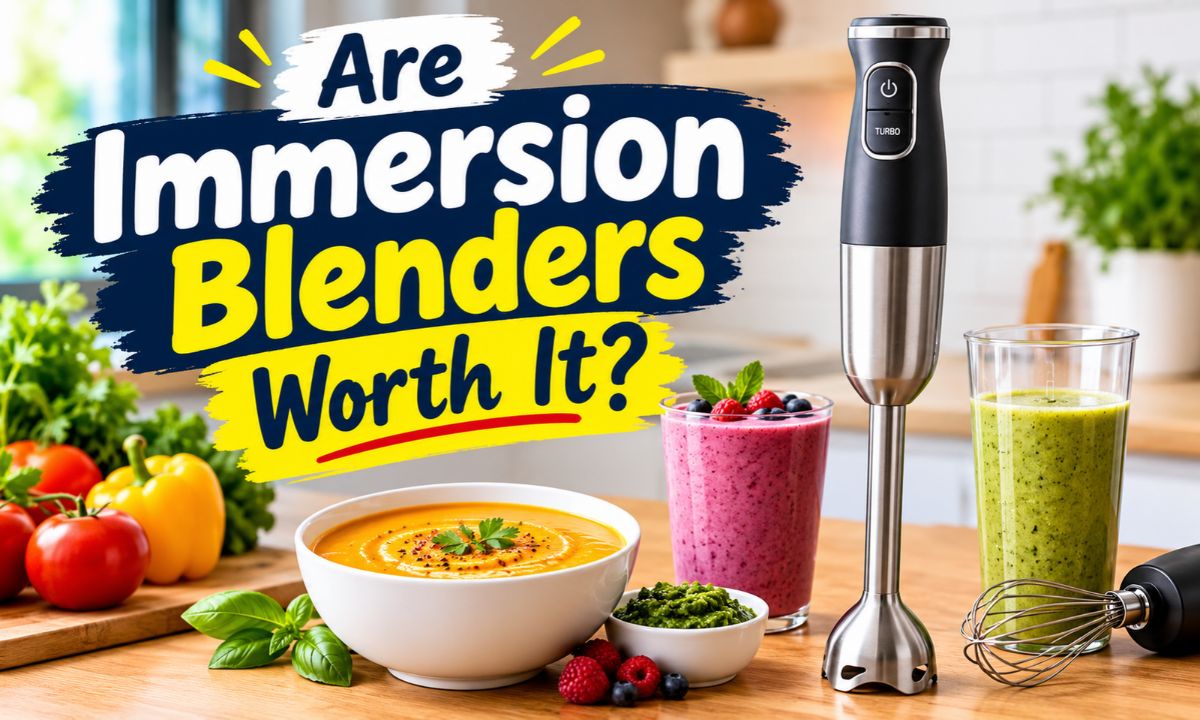
Immersion blenders are worth it if you often make soups, sauces, dips, or small batches of blended food.
In American kitchens, an immersion blender can save time when you make tomato soup, blend a pot of chili, prepare homemade salad dressing, or whip up a quick sauce for dinner. Instead of pouring hot food into a countertop blender, you can often blend it right in the cooking pot. This can mean fewer dishes, less mess, and less work after a busy meal.
Still, an immersion blender is not the right tool for every kitchen. It usually takes up less space than a full-size blender, but it may struggle with thick mixtures, large batches, and ice. Whether it is worth buying depends on what you cook, how often you blend food, and whether you already own other kitchen appliances.
This guide explains what immersion blenders do well, where they fall short, how they compare with countertop blenders and food processors, and what to consider before spending your money. The goal is simple: help you decide whether a hand blender would make your everyday cooking easier.
An immersion blender is a handheld kitchen tool with a motor in the handle and a rotating blade at the end of a long shaft. You place the blade end into a container of food and switch it on to blend the contents. It is also called a hand blender or stick blender.
Unlike a countertop blender, which requires food to go into a separate blending jar, an immersion blender can work inside many cooking pots, bowls, and tall containers. This makes it especially useful when a recipe calls for blending food that is already cooking.
Most models have a blending shaft with a protective guard around the blade. Some have variable speeds, while others use a few fixed settings. Certain models also include attachments for whisking, chopping, or processing food, but these extra tools depend on the product.
The key difference is convenience. An immersion blender brings the blade to the food rather than requiring you to move the food into a separate appliance.
Corded models
These plug into a wall outlet and provide power for as long as the appliance is connected. The cord can limit where you work, so check its length and keep it away from hot burners.
Cordless models
These use a rechargeable battery and allow more freedom of movement. You must manage battery life and charging, and their performance depends on the specific model.
Models with accessories
Some include a whisk, blending cup, or small chopper. These extras can add value if you will use them, but they do not make every model suitable for every kitchen task.
What Can You Make With an Immersion Blender?
An immersion blender is worth considering if you often prepare foods that need to become smooth, creamy, or evenly mixed. Its greatest strength is blending soft or cooked ingredients without moving them into another container.
It can handle many everyday recipes, from a quick lunch to a sauce for a family dinner. Results depend on the blade design, motor, container shape, ingredient size, and how thick the mixture is.
Soups
Blend cooked vegetables, beans, and broth into a smooth soup directly in a suitable pot after removing it from the heat and allowing it to cool as needed. This works well for tomato soup, pumpkin soup, potato soup, and many vegetable soups.
Sauces and gravies
Blend cooked tomatoes, roasted vegetables, or other soft ingredients into a more even sauce. A hand blender can also help combine ingredients when a sauce has small lumps.
Smoothies
Make small smoothies with soft fruit and enough liquid in a tall, narrow container. It can be convenient for a single serving, though a countertop blender may perform better with frozen fruit or fibrous ingredients.
Dips and spreads
Blend cooked beans, soft vegetables, and other moist ingredients for dips and spreads. Very thick mixtures may need extra liquid or occasional stirring, and some are better suited to a food processor.
Salad dressings
Combine oil, vinegar, mustard, herbs, and other dressing ingredients. A suitable blending cup helps limit splashes when making a small amount.
Purees for children and adults
Turn cooked vegetables, fruit, and other soft foods into a puree. Allow food to reach a suitable temperature, and check the texture carefully for the person who will eat it.
Small batches of sauces and spreads
Prepare a quick herb sauce, mayonnaise-style dressing, or other recipe that benefits from emulsification. Follow a tested recipe and use the right container, since ingredient ratios and technique affect the result.
Is an Immersion Blender Good for Soup?
Yes. Soup is one of the strongest reasons to own an immersion blender. Once vegetables and other ingredients are cooked, you can blend them in the pot instead of transferring hot liquid to a countertop blender.
For a smooth result, move the blade slowly through the food while keeping the blade guard under the surface. If the soup is thick, stir it and add liquid a little at a time if the recipe allows. Some soups contain skins, seeds, or fibrous ingredients that may remain slightly textured.
Safety matters when blending hot food. Remove the pot from the burner, keep the blade submerged before switching it on, and follow the manufacturer’s temperature and use instructions. Avoid sudden movements that could spray hot liquid.
Best result
Use a pot deep enough to keep the blade fully submerged without letting it strike the bottom or sides with force.
When it may struggle
Very thick soup, tough vegetable fibers, or large pieces may need more cooking, additional liquid, or a different appliance.
Can You Make Smoothies With a Hand Blender?
You can make many small smoothies with an immersion blender, especially when you use fresh or thawed fruit and enough liquid. A tall blending cup helps keep ingredients close to the blade and reduces splashing.
Frozen fruit, ice cubes, and tough greens are more demanding. Some immersion blenders are designed to handle certain frozen ingredients, but others may stall, overheat, or produce an uneven texture. Check the manual before attempting these tasks.
If smoothies are part of your daily routine and you want to blend several servings at once, a countertop blender may be a better investment.
Use enough liquid
Milk, water, juice, or another suitable liquid helps ingredients move toward the blade.
Cut fruit into smaller pieces
Smaller pieces can make blending easier, especially when using a narrow container.
The Main Benefits of an Immersion Blender
The biggest benefits of an immersion blender are convenience, easy storage, and less cleanup. These advantages matter most when you prepare small amounts of blended food or regularly cook recipes that start on the stove.
A hand blender will not replace every kitchen appliance. However, it can make certain jobs quicker because you can blend food where it is already being prepared.
Less cleanup
Blending soup in a cooking pot can eliminate the need to wash a separate blender jar. You still need to clean the blending shaft and blade area.
Compact storage
The main unit is usually slim and easy to place in a kitchen drawer or cabinet. Models with several attachments may need more room.
Convenient for small portions
A hand blender can work well for a single serving of sauce, a small bowl of puree, or a quick dressing when the container is suitable.
Direct control
You can move the blade through different parts of the mixture and stop when the texture suits your recipe.
Useful during cooking
You can blend cooked ingredients without planning an extra transfer step, provided the pot and food temperature are appropriate.
Potentially lower cost
Many basic immersion blenders cost less than full-size countertop blenders. Actual prices vary, and premium hand blenders can cost more than some basic countertop models.
Why Fewer Dishes Can Matter
The cleanup benefit is easy to understand. With a countertop blender, you may need to wash the jar, lid, blade assembly, and any container used to transfer food. With an immersion blender, you can often use the cooking pot and wash the blender shaft afterward.
This does not mean cleanup is automatic. Food can collect around the blade guard, and some shafts detach while others do not. A dishwasher-safe part can help, but you should confirm the instructions for your exact model.
Best fit
People who make soup, sauces, or purees several times a week may notice the convenience more than occasional users.
Small trade-off
A narrow blade guard may take careful rinsing, and the motor handle should never be submerged unless the manufacturer specifically allows it.
The Downsides You Should Know Before Buying
An immersion blender is useful, but it has limits. It is designed to bring a small, fast-moving blade to food, not to perform every job handled by a powerful countertop blender, food processor, or stand mixer.
The main drawbacks are limited capacity, possible splashing, uneven results with some ingredients, and the need to hold the appliance while it runs. These issues may matter more if you prepare large batches or want a completely smooth drink every morning.
Limited batch size
A hand blender works best when its blade can reach the food and move through it. Wide pots, shallow bowls, or very large batches may make blending harder.
Less effective with some hard ingredients
Hard nuts, whole spices, dry grains, and large amounts of ice can exceed the intended use of many models. Use a grinder or another appliance designed for the task.
Possible splashes
Lifting the blade above the surface while it runs can spray food. Starting at a high speed can also make splashing more likely.
Hand and arm effort
You must hold and guide the appliance during use. Long blending sessions may be tiring, especially when preparing a large pot.
Texture can vary
Some mixtures may remain grainy or fibrous. The result depends on the ingredients, cooking time, liquid level, blade design, and blending technique.
Motor heat and wear
Running a blender for longer than its recommended duty cycle can cause overheating. Follow the manual’s limits and let the motor rest when required.
Can an Immersion Blender Crush Ice?
Do not assume that every immersion blender can crush ice. Ice is hard and can place heavy stress on a small motor and blade assembly. Some models or approved accessories may support specific ice-related tasks, but the manufacturer’s instructions determine what is allowed.
If you regularly make frozen cocktails, crushed-ice drinks, or smoothies packed with frozen ingredients, a suitable countertop blender is often the more practical choice. Using an appliance outside its stated limits can damage it and may create a safety risk.
Check the manual
Look for explicit instructions about ice, frozen fruit, and hard ingredients rather than relying on motor wattage alone.
Choose the right tool
A blender designed for ice offers a better starting point for frequent frozen drinks.
Why Does an Immersion Blender Leave Lumps?
Lumps can remain when ingredients are too large, too firm, too dry, or outside the appliance’s capabilities. A blade also needs enough liquid and room to move food through its cutting area.
Cook vegetables until tender when the recipe calls for a smooth soup or puree. Cut large pieces into smaller ones, add suitable liquid gradually, and move the blade around the mixture without lifting it above the surface.
If the food still has tough fibers or hard pieces, stop the blender and assess the ingredients. Do not force the blade through a blockage or use your fingers to clear food while the appliance is plugged in.
First check
Confirm that the food is soft enough and the blade is fully submerged.
Next step
Stir the mixture, add liquid if appropriate, and blend in short bursts within the manual’s operating limits.
Immersion Blender vs. Countertop Blender
An immersion blender is usually better for blending food in a pot or making small batches with little setup. A countertop blender is often better for larger amounts, drinks that need a very smooth texture, and tasks its manufacturer specifically supports, such as crushing ice.
Neither appliance is automatically better. The right choice depends on what you make, how much you prepare, how much storage space you have, and whether you already own a suitable blender.
Choose an immersion blender for soup
It can blend cooked ingredients directly in a suitable pot, reducing transfers and extra dishes.
Choose a countertop blender for large batches
Its jar provides a dedicated blending space and may handle larger quantities more consistently, as long as you stay within its fill limits.
Choose a countertop blender for frequent frozen drinks
A model designed for ice and frozen ingredients is generally more suitable than a hand blender that lacks those capabilities.
Choose an immersion blender for compact storage
The main unit is generally slim and does not require space for a large blending jar.
Which Blender Makes Smoother Smoothies?
A countertop blender often has the advantage when you want very smooth smoothies, especially those made with frozen fruit, ice, or fibrous vegetables. Its jar and blade system are designed to process a contained mixture, though results vary by model.
An immersion blender can still work well for a small smoothie made with soft fruit and enough liquid. The key is to use a suitable cup, keep the blade submerged, and avoid ingredients the manufacturer does not permit.
If you make a smoothie once in a while, buying a second appliance may not be worthwhile. If you blend large or frozen drinks daily, compare the performance and capacity of the countertop models you are considering.
For occasional small drinks
An immersion blender may be sufficient when ingredients are soft and the portion is small.
For daily frozen smoothies
A countertop blender with documented frozen-ingredient capability is usually a more suitable choice.
Immersion Blender vs. Food Processor
A food processor is designed for jobs such as chopping, slicing, shredding, and processing ingredients into mixtures with different textures. An immersion blender is designed mainly for blending liquids and soft foods into a smoother result.
For example, a hand blender can turn cooked tomatoes into a sauce, while a food processor is usually more practical for chopping onions, shredding vegetables, or preparing a thick mixture that needs a broad bowl and a chopping blade.
Some immersion blender sets include a small chopper attachment. This can be useful for modest amounts of suitable ingredients, but it does not make the hand blender equivalent to a full-size food processor in capacity or function.
For soups and smooth sauces
An immersion blender is often the more direct option.
For chopping and slicing
A food processor with the appropriate blade or disc is usually the better tool.
For thick mixtures
Compare the manufacturer’s stated uses and limits. Some thick foods are easier to process in a food processor.
For occasional chopping
An immersion blender kit with an approved chopper attachment may be enough if the batch is small.
How Much Should You Spend on an Immersion Blender?
The right price depends on how often you will use the blender and which features matter to you. Basic models may be enough for occasional soup and sauce preparation, while more expensive options may offer adjustable speeds, a more comfortable grip, additional attachments, or cordless operation.
Prices and product ranges change, so it is better to compare current listings than rely on a fixed price estimate. A high price alone does not prove that a blender will produce smoother results or last longer.
Before buying, look at the manufacturer’s stated uses, cleaning instructions, warranty terms, and any limits on continuous operation. These details may matter more than a long list of attachments.
Basic models
Consider these if you mainly blend soup, soft vegetables, and simple sauces. Check whether the speed controls and blending shaft suit your usual recipes.
Midrange models
These may offer better control, a more comfortable handle, or a useful accessory. Decide whether those features solve a real problem in your kitchen.
Premium models
These may include more accessories or cordless designs. The extra cost makes sense only if you value the added features and expect to use them.
How to Judge Value Beyond the Purchase Price
A low-cost appliance can be good value if it handles your normal recipes and is easy to clean. A more expensive model may be worth the difference if you use it often and its features save time or make blending easier.
Think about the cost per use rather than the purchase price alone. For example, if you use a hypothetical $40 blender twice each week for two years, that works out to about 38 cents per use before electricity, accessories, or replacement costs. This is a simple illustration, not a prediction of product life.
The calculation is only useful if you choose a product that suits your needs. A cheap blender that cannot handle your regular recipes may be a worse purchase than a moderately priced model that can.
Check the warranty
Understand the coverage period, exclusions, and steps required for service.
Check replacement parts
See whether the manufacturer offers replacement shafts, accessories, or other parts if they are needed.
Check cleaning requirements
A model that is easy to clean may be more useful than one with accessories you rarely need.
What to Look for When Buying an Immersion Blender
The best immersion blender for your kitchen is one that fits your recipes, feels comfortable to hold, and can be cleaned without much effort. You do not need every available feature to make a good purchase.
Start with the tasks you perform most often. If you mostly make soup, a straightforward model with a suitable shaft and speed control may be enough. If you also want to whisk eggs or chop small amounts of food, compare models that include those attachments.
Motor performance
Compare the manufacturer’s power information with the intended use. Wattage alone does not establish blending quality, durability, or suitability for ice.
Speed control
Variable speed or a gentle starting mode can help you control splashing and adjust the texture of different foods.
Blade guard design
A well-designed guard can help contain splashes and protect the blade area. It does not eliminate the need to keep the blade submerged.
Comfort and weight
Choose a handle you can grip comfortably. A heavy unit may become tiring during longer blending sessions.
Detachable shaft
A removable blending shaft can make cleaning and storage easier. Check how the shaft locks into place and whether the parts are dishwasher-safe.
Corded or cordless design
A corded model avoids battery charging, while a cordless one allows more freedom of movement. Consider your kitchen layout and expected session length.
Included accessories
Buy attachments only when they support tasks you will actually perform. Extra tools can increase the price and storage needs.
Warranty and support
Review the warranty, service options, and availability of replacement parts before purchasing.
Do You Need a Powerful Immersion Blender?
You need enough power for your normal recipes, but the highest wattage is not automatically the best choice. Blade design, speed control, food consistency, container shape, and the manufacturer’s intended uses also affect results.
For occasional soups and soft sauces, a basic model may be adequate. For frequent blending of dense mixtures, look for a model that explicitly supports those tasks and has clear instructions about operating time.
Avoid using motor specifications as a substitute for testing evidence. If a manufacturer does not document a particular task, do not assume that the blender can perform it safely just because its wattage looks high.
Match power to the recipe
Choose according to the ingredients and quantities you expect to blend most often.
Check operating limits
Follow the stated maximum run time and rest periods to help prevent overheating.
How to Use an Immersion Blender Safely and Effectively
Using an immersion blender correctly helps produce a smoother result while reducing splashes and the risk of injury. Read the instructions for your model before its first use, since attachment design and operating limits vary.
The main rule is to keep the blade end under the food while the motor is running. Do not touch the blade, clear a blockage, or change attachments while the appliance is connected to power.
Hot food warning
Remove the pot from the heat before blending and follow the model’s temperature instructions. Hot liquid can splash and cause serious burns.
Electrical safety
Keep plugs, cords, and motor housings dry. Do not operate a damaged appliance or use it near water in a way that violates its instructions.
Step 1: Choose a Suitable Container
Use a deep pot, tall blending cup, or other container that gives the blade enough room to move. A narrow, tall container can help control splashes when making a small batch.
Avoid containers that are too shallow or narrow for the blade guard. Make sure the blender cannot tip the container or strike its sides with force.
For soup
Choose a stable pot with enough depth to keep the blade submerged.
For smoothies or dressing
Use a suitable cup that leaves enough room for the ingredients to move without overflowing.
Step 2: Prepare the Ingredients
Cook firm vegetables until tender when the recipe requires a smooth puree. Cut large ingredients into smaller pieces and add enough liquid for the blade to move through the mixture.
Remove hard pits, bones, packaging, and other unsuitable items before blending. Check the manual before using frozen ingredients or anything particularly hard.
Use suitable ingredients
Soft, cooked, or adequately chopped ingredients are generally easier to blend.
Avoid overfilling
Leave room for food to move and for the mixture to rise slightly during blending.
Step 3: Position the Blade Before Switching It On
Place the blade end into the food before starting the motor. Keep the blade guard below the surface and hold the blender at a steady angle recommended by the manufacturer.
Start at a low speed when available, especially when working with thin liquids. Increase the speed only as needed to reduce splashing and maintain control.
Keep the blade submerged
Do not switch on the blender while the blade is above the food or lift it out while it is spinning.
Maintain a steady grip
Hold the appliance firmly and keep the cord away from the pot, hot surfaces, and moving parts.
Step 4: Blend in Short, Controlled Movements
Move the blender slowly through the food, using short bursts when appropriate. Avoid pressing the blade hard against the bottom of the pot or lifting it above the surface while it runs.
Stop periodically to stir the mixture and inspect the texture. If the recipe needs more blending, continue within the operating limits in the manual.
For a smooth soup
Move the blade through different areas of the pot so the ingredients blend evenly.
For a thick mixture
Stop the motor before stirring or adding liquid, then resume only when it is safe to do so.
Step 5: Switch Off Before Removing or Cleaning
Switch off the motor before lifting the blade out of the mixture. Unplug the appliance before removing attachments or cleaning near the blade, unless the manufacturer provides a different safe procedure for a cordless model.
Clean the shaft and blade area according to the instructions. Keep the motor housing away from water unless the manufacturer explicitly states that a particular part is waterproof.
Inspect the blade area
Make sure food is not stuck around the guard or cutting edge before storing the blender.
Store it safely
Keep the sharp blade away from children and protect it from damage during storage.
How to Clean and Maintain an Immersion Blender
Regular cleaning helps keep an immersion blender ready for use and prevents food residue from collecting around the blade guard. The correct method depends on whether the shaft detaches and which parts the manufacturer allows you to wash.
Never assume that the whole appliance is waterproof. The motor housing contains electrical components, so keep it dry unless the product instructions specifically permit washing it.
A Simple Cleaning Routine
Switch off and unplug the blender before removing the shaft or handling the blade area. If the shaft is detachable, remove it according to the manual and wash it using the approved method.
For food residue around the blade guard, use a soft brush or sponge and avoid touching the cutting edge directly. Rinse and dry the parts as instructed before putting them away.
Clean soon after use
Removing fresh food residue is often easier than dealing with dried-on sauce or soup.
Check dishwasher instructions
Some removable parts may be dishwasher-safe, but the motor unit and other components may not be.
Inspect the cord and housing
Stop using the appliance if you notice damaged insulation, cracks, unusual heat, or other signs of damage.
Signs Your Blender May Need Attention
A blender that suddenly loses performance, makes unusual noises, or develops a burning smell may have a blockage, overheating problem, or mechanical fault. Switch it off and disconnect the power before checking for visible residue or damage.
Let the motor cool if the manual calls for a rest period, and never force the blade through a blockage. If the appliance continues to behave abnormally, contact the manufacturer or a qualified repair service rather than opening an electrical motor housing yourself.
Repeated overheating
Check the stated run-time limit, ingredient suitability, and any blockage before using the appliance again.
Damaged blade or shaft
Stop using the blender until the damaged part has been replaced or the appliance has been assessed.
Burning smell or sparks
Disconnect power if it is safe to do so and stop using the blender. Seek appropriate service or replacement.
Who Should Buy an Immersion Blender?
An immersion blender is most worthwhile for people who regularly make soups, sauces, purees, dips, or small blended meals. It can also suit home cooks who want a compact appliance and prefer not to wash a large blender jar after every use.
The value is less clear for people who rarely blend food or already own appliances that handle their usual recipes. Buying a new tool makes sense when it solves a recurring problem, not simply because it offers another kitchen function.
Buy one if you make soup often
Blending cooked ingredients in the pot can reduce transfers and cleanup.
Buy one if cabinet space is limited
The main unit is compact and may fit where a full-size blender would be awkward to store.
Buy one if you make small portions
A hand blender can be convenient for a quick dressing, dip, or single-serving drink.
Think twice if you mostly make frozen smoothies
A suitable countertop blender may better match your routine.
Think twice if you rarely blend anything
Your existing blender, food processor, or another suitable appliance may already cover your needs.
Is an Immersion Blender Worth It for One Person?
It can be. People who cook for one may appreciate the ability to blend a small serving of soup, sauce, or puree without setting up a full-size blender.
However, the amount of food still matters. A very small portion may not reach the blade properly in a wide container, so a narrow cup or small pot may be more effective. Check the minimum quantity recommended by the manufacturer if one is provided.
If your meals rarely include blended ingredients, even a compact appliance may take up space without delivering much benefit.
Good fit
You regularly prepare small batches of soup, dressing, or soft-food puree.
Less useful
You mainly eat whole foods and seldom make sauces, soups, or blended drinks.
Is an Immersion Blender Worth It for a Family?
For a family, an immersion blender can be useful when you prepare a pot of soup or sauce for several people. It can blend the batch without requiring you to move it into a separate jar, provided the pot and blender are suitable for the quantity.
A family that makes large smoothies, frozen drinks, or big batches of nut-based mixtures may benefit more from a countertop blender or food processor. Some households may find that owning both tools covers different tasks, but a second appliance is not essential for everyone.
Good fit
Your family eats homemade soups, sauces, and purees often.
Consider an alternative
Your main blending tasks involve large drinks or ingredients that need a specialized appliance.
Common Immersion Blender Buying Mistakes
The most common buying mistake is choosing a blender based on its price or advertised power without checking whether it suits your recipes. A good purchase starts with the foods you actually make and the tasks you want the appliance to handle.
A few checks can help prevent disappointment and reduce the chance of damaging the appliance.
Assuming every model can crush ice
Check the manual for explicit support before blending ice or frozen ingredients.
Buying unnecessary attachments
Extra accessories add storage needs and may increase the price. Choose them only when they serve a clear purpose.
Ignoring cleaning instructions
A model with a difficult-to-clean shaft may become less convenient if you use it often.
Choosing a container that is too shallow
A shallow bowl can increase splashing and make it harder to keep the blade submerged.
Expecting every mixture to become perfectly smooth
Some ingredients need more cooking, liquid, or a different appliance to achieve the desired texture.
Ignoring operating limits
Continuous use beyond the stated limit may cause overheating. Follow the instructions for run time and rest periods.
Buying without checking the warranty
Review coverage and replacement-part availability before committing to a model.
A Simple Decision Guide: Is It Worth Buying?
The easiest way to decide is to count the tasks an immersion blender would make easier. Focus on the recipes you prepare now rather than imagined uses that may never become part of your routine.
Use the table below to match common cooking habits with a practical recommendation. These are general guidelines, not performance guarantees for every model.
Match Your Cooking Habits to the Right Appliance
If you frequently blend food in a pot, an immersion blender may be a sensible purchase. If you mainly make large frozen drinks, a countertop blender designed for those ingredients is likely a better fit.
Frequent homemade soup
An immersion blender is likely worth considering because it can blend directly in a suitable pot.
Occasional sauces and dips
A basic immersion blender may offer enough convenience without taking up much space.
Daily frozen smoothies
A suitable countertop blender may better handle your normal workload.
Regular chopping and slicing
A food processor is generally more appropriate for these tasks.
Very limited storage
A compact immersion blender may be easier to store than a full-size blender, although accessories still take up space.
Rarely blended food
Keep using the appliances you already own unless you identify a repeated task they cannot handle conveniently.
The Three-Question Test
Before buying, ask yourself three simple questions. First, do you make soups, sauces, dips, or purees at least often enough to justify another appliance? Second, would blending directly in the cooking pot save time or cleanup? Third, can the immersion blender handle your main recipes within its stated limits?
If you answer yes to all three, a hand blender is likely to provide practical value. If you answer no to most of them, you may be better off saving the money or choosing a different appliance.
Identify your main use
Write down the two or three recipes you expect to make most often.
Check model limits
Confirm that the blender is intended for those foods and quantities.
Compare the total value
Consider storage, cleaning, accessories, warranty, and how often you will use the appliance.
Research Notes and Useful Next Questions
The practical recommendations in this guide are based on the general functions and limitations of immersion blenders, not on a hands-on comparison of specific products. No particular model has been tested for this article, and no current prices, durability measurements, or independent performance rankings are claimed.
For a purchase decision, the most useful next step is to review the instructions for the exact model you are considering. The manual can confirm whether the appliance supports hot food, frozen ingredients, specific attachments, dishwasher cleaning, and the run times you need.
Question: Can it blend hot soup?
Reader stage: before use. Basis: inferred next need. Coverage in this guide: answered. Benefit: helps prevent splashes and unsafe handling. Evidence needed for a specific model: its official instructions.
Question: Can it replace a countertop blender?
Reader stage: before purchase. Basis: inferred next need. Coverage in this guide: answered with task-based trade-offs. Benefit: avoids buying the wrong appliance. Evidence needed for a specific model: documented capacity and permitted uses.
Question: How should the appliance be cleaned?
Reader stage: after use. Basis: inferred next need. Coverage in this guide: answered generally. Benefit: helps protect the motor and blade. Evidence needed for a specific model: official cleaning and dishwasher guidance.
Question: Will a low-cost model last?
Reader stage: before purchase. Basis: inferred next need. Coverage in this guide: partly answered. Benefit: encourages comparison of warranty, service, and intended use. Evidence needed: long-term reliability data for the exact model.
Question: Which model is best for my budget?
Reader stage: product selection. Basis: inferred next need. Coverage in this guide: not assessed at the model level. Benefit: supports a more informed comparison. Evidence needed: current product listings, manuals, warranty details, and reliable comparative testing.
Frequently Asked Questions
Q
Are immersion blenders worth buying?
Yes, if you regularly make soups, sauces, dips, purees, or small batches of blended food. They are compact and can reduce cleanup by blending food directly in a suitable pot or container. If you rarely blend food or mainly make large frozen drinks, another appliance may offer better value.
Q
Can an immersion blender replace a regular blender?
It can replace a countertop blender for some tasks, especially soup, sauce, and small batches of soft food. It may not match a countertop blender for large batches, ice, frozen drinks, or certain thick mixtures. The best choice depends on your recipes and the capabilities of each model.
Q
Can you use an immersion blender in a hot pot?
Many immersion blenders are intended for blending cooked foods, including soup, but you must follow the specific model’s temperature and use instructions. Remove the pot from the heat when appropriate, keep the blade submerged, and avoid sudden movements that could spray hot liquid. Hot food can cause serious burns.
Q
Can an immersion blender make a smoothie every day?
Yes, it can make small smoothies from soft fruit and enough liquid when the ingredients and container suit the appliance. Frozen fruit, ice, and tough greens may be harder to blend. If you make large or heavily frozen smoothies every day, consider a countertop blender designed for those ingredients.
Q
Are immersion blenders easy to clean?
They are often easy to clean because you may not need to wash a large blender jar. Switch off and unplug the appliance before removing attachments or handling the blade. Clean the shaft according to the manual, and never submerge the motor housing unless the manufacturer explicitly allows it.
Q
What should you not blend with an immersion blender?
Avoid ingredients that the manufacturer does not permit, which may include ice, hard nuts, whole spices, dry grains, or very dense mixtures. Do not force the blade through hard pieces or operate it when blocked. Use an appliance designed for the task when your recipe exceeds the blender’s stated limits.
Q
Is a cordless immersion blender better than a corded one?
Neither type is automatically better. Cordless models offer more freedom of movement but require charging and have limited battery life. Corded models avoid battery management but keep you near an outlet. Choose according to your kitchen layout, expected use, and the performance of the specific model.
Q
How long does an immersion blender last?
There is no single lifespan that applies to every model. Durability depends on build quality, frequency of use, cleaning, storage, ingredient demands, and whether the appliance is operated within its limits. Review the warranty and availability of replacement parts, and stop using the blender if it develops electrical damage or persistent mechanical problems.
✦ Wrapping Up
Conclusion
Immersion blenders are worth it for many home cooks, especially those who regularly prepare soups, sauces, dips, purees, and small portions of blended food. Their main benefits are straightforward: less setup, fewer dishes in many recipes, compact storage, and the ability to blend food directly in a suitable pot or container.
They are not a complete replacement for every kitchen appliance. A countertop blender is often a better fit for large batches and frozen drinks, while a food processor is more useful for chopping and slicing. An immersion blender may also struggle with very thick or hard ingredients, so check the manufacturer’s instructions before use.
The smartest purchase is the one that fits your actual cooking habits. If blending soup or sauce is a regular part of your week, a hand blender can earn its place in your kitchen. If you rarely make blended food, you may not need one at all.
💡 Key Takeaway
Before buying, list the recipes you make most often, check the model’s permitted uses and cleaning instructions, and compare its price with the value it will add to your everyday cooking.