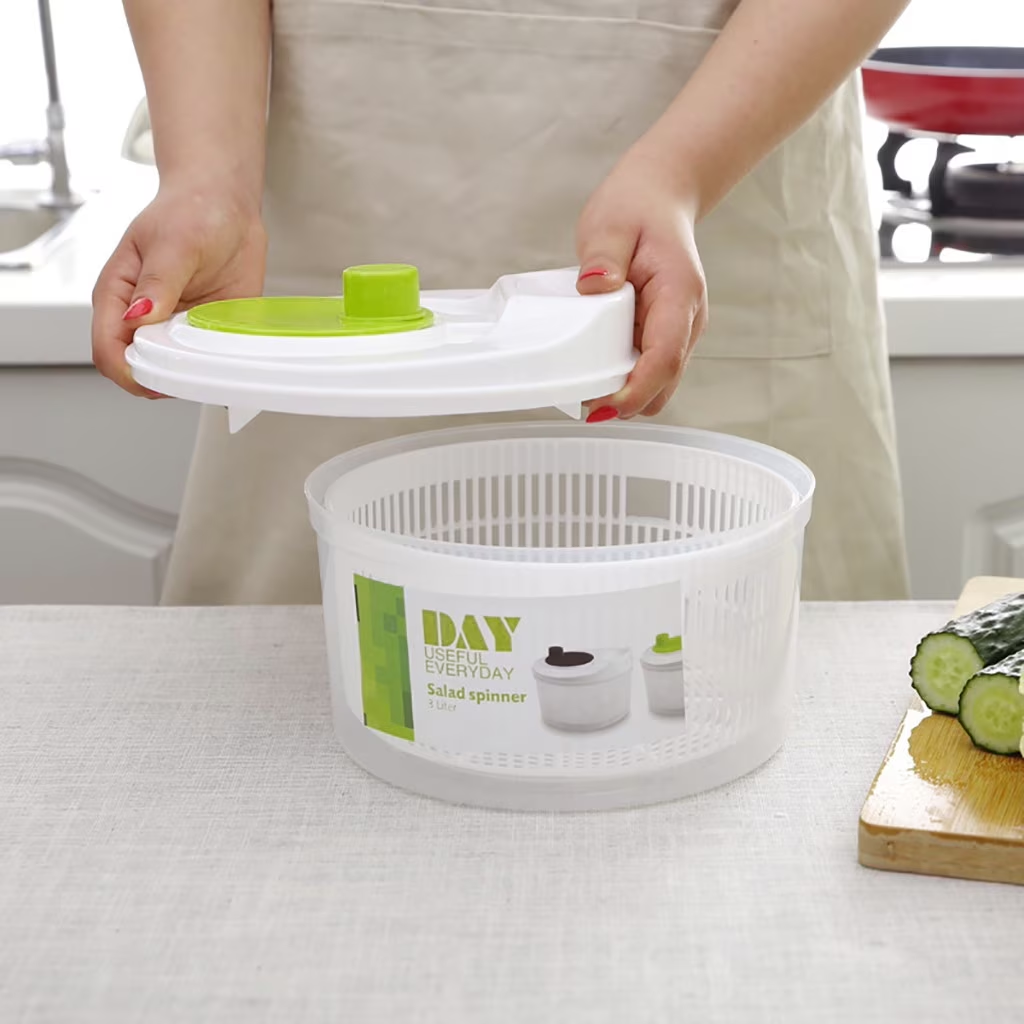
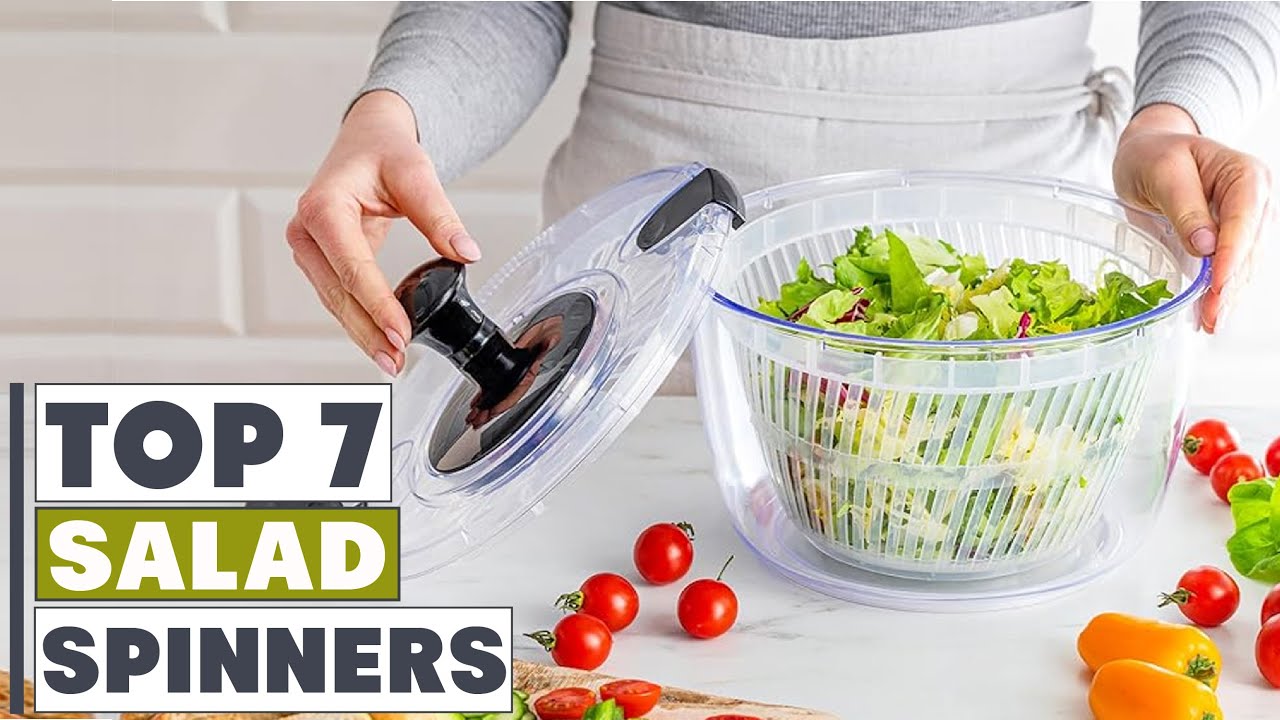
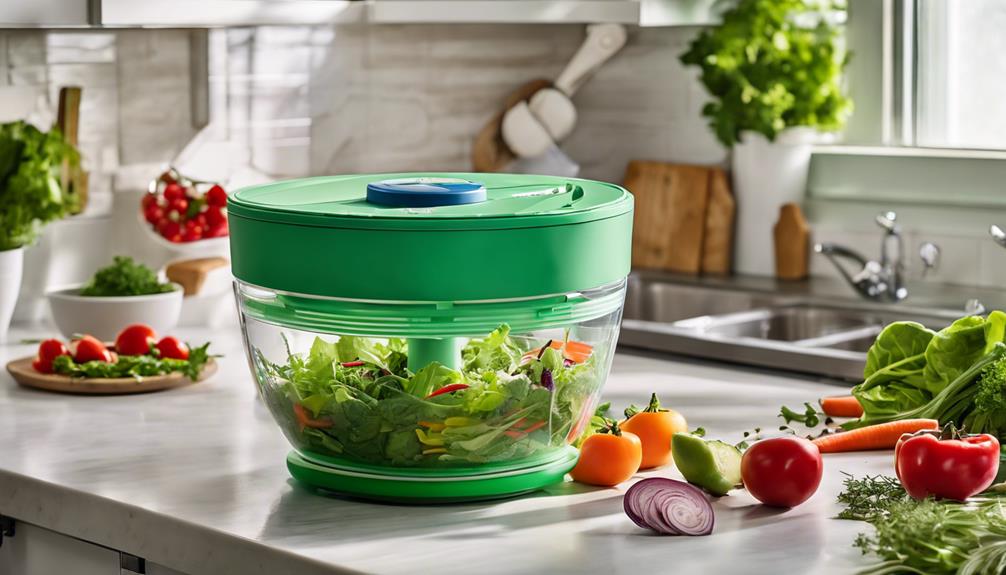
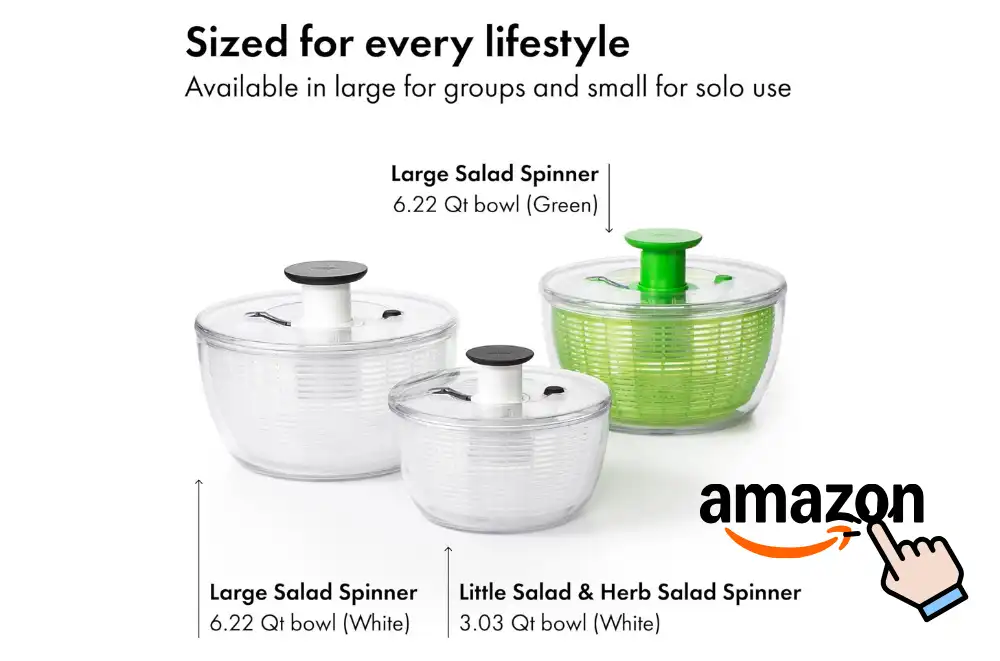
A 5- to 6-quart salad spinner is a good starting point for most families of four to six people. Choose a 4- to 5-quart model for smaller households and a 6-quart or larger model for bigger families or large meal-prep batches.
In American homes, salad is often part of dinner, a quick lunch, or a weekend cookout. If you regularly wash romaine, spinach, spring mix, or fresh garden greens for the whole family, a small salad spinner can quickly become a hassle. You may have to wash the same leaves in several rounds, which adds time to meal prep.
The right size depends on more than the number of people at your table. Think about how much lettuce you wash at once, whether you make large main-course salads, and how much cabinet space you have. A family that eats a small side salad may need less room than a couple who prepares large bowls of greens for weekly meals.
A salad spinner has two main parts: an outer bowl and an inner basket. The basket holds the washed greens while spinning removes extra water. This means the usable basket capacity matters more than the total bowl capacity when you compare sizes. A large outer bowl does not always mean you can fit the same amount of lettuce inside the basket.
This guide explains which capacity works for different household sizes, how to compare quarts and liters, and when a larger spinner is worth the extra storage space. You will also learn how to load it properly so your greens dry well without getting crushed.
What Size Salad Spinner Is Best for Different Family Sizes?
The best salad spinner size depends on how many servings you prepare in one batch. For most families, a 5- to 6-quart model offers a useful balance between capacity and storage. It can handle a good amount of leafy greens without taking up as much room as a commercial spinner.
Use the following sizes as shopping starting points rather than strict serving limits. A basket filled with loose spinach takes up a different amount of space than one filled with chopped romaine. Your meal style also matters.
For example, a family that serves a small side salad with grilled chicken may use much less lettuce than a family that makes a large salad as the main meal. The table below helps you narrow down your choices.
Source: i5.walmartimages.com
One or two people: 2 to 3 quarts
A compact spinner is usually enough for small salads, fresh herbs, and occasional fruit washing. It is also easier to store in a small kitchen.
Three people: 3 to 4 quarts
This size can work well for regular side salads. Choose a larger basket if you often prepare full dinner salads or wash greens for several meals.
Four people: 5 to 6 quarts
This is a useful range for a typical family. It offers more room for lettuce and reduces the need to divide an ordinary family batch into several loads.
Five or six people: 5 to 6 quarts or larger
A full-size model is a sensible choice for regular family meals. Consider a larger basket if everyone eats large portions of greens.
Seven or more people: 6 to 8 quarts or larger
A larger household may benefit from extra capacity, especially when serving salad as a main dish or preparing food for guests.
A Small Family of Two or Three
A 3- to 4-quart salad spinner is often enough for a small family. It can handle a few servings of lettuce without leaving you with a bulky bowl to store after every use.
This size is also useful if your kitchen has limited cabinet space. You can place it on a shelf, in a deep drawer, or inside a larger kitchen cabinet, depending on its shape.
However, think about your largest regular meal. If you often make large Caesar salads or prepare several lunch portions at once, a 5-quart model may save you from spinning multiple batches.
Best starting size
3 to 4 quarts for small daily salads and simple meal prep.
When to size up
Choose 5 quarts if you often wash a full head of lettuce or prepare food for guests.
A Family of Four
For a family of four, a 5- to 6-quart salad spinner is a practical choice. It provides room for a useful batch of greens and gives you some flexibility when preparing different types of salads.
A 4-quart model may still work if salad is only a small side dish. But if you serve leafy greens several times a week, the extra room in a larger basket can make washing easier.
A full-size spinner can also help when you prepare lettuce for packed lunches. You can wash the greens in a batch, dry them, and divide them into meal portions for later use.
Best starting size
5 to 6 quarts for regular family salads.
Useful extra feature
A removable basket that also works as a colander can make rinsing and draining easier.
A Large Family of Five or More
A family of five or more may find a 6-quart or larger spinner more useful. This is especially true if you make large dinner salads, host family meals, or prepare greens for several days at once.
A larger basket can reduce the number of batches you need to wash. Still, do not assume that every large model will hold a full family-sized amount of lettuce. Check the basket dimensions and usable capacity before buying.
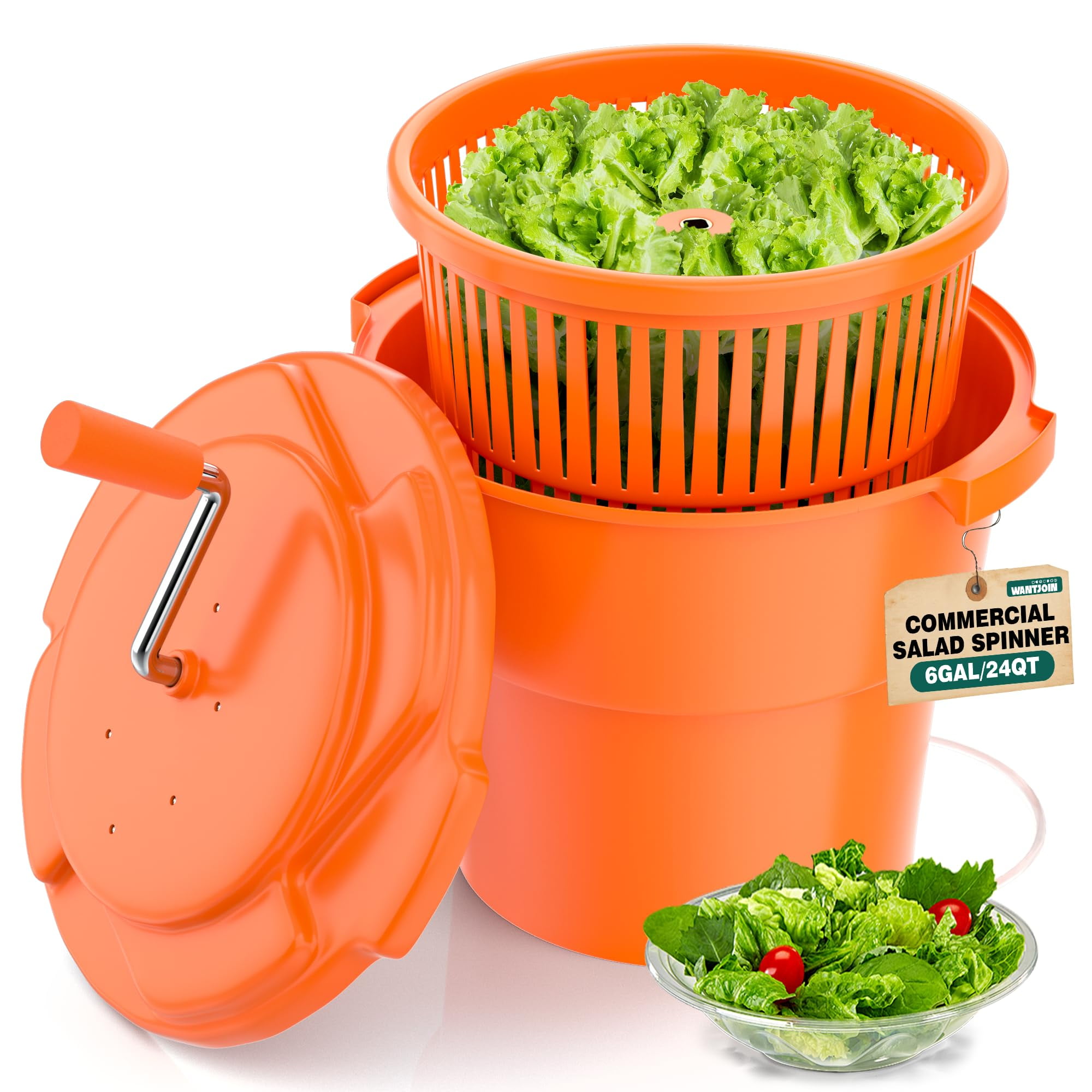
If you regularly cook for a large group, you may even consider a commercial-style spinner. These models can be much larger than ordinary home units, so measure your kitchen space carefully before choosing one.
Best starting size
6 to 8 quarts or more, depending on how much produce you wash.
Best for frequent large batches
A wide basket with a stable base and a secure lid.
Understand Salad Spinner Capacity Before You Buy
Salad spinner capacity can be confusing because manufacturers may list the bowl capacity, basket capacity, or both. These numbers do not always mean the same thing.
The outer bowl catches water as the basket spins. The inner basket holds the lettuce and other produce. Since the basket is the part that limits how much food you can load, its capacity is usually the more useful number for family meal prep.
For example, an OXO Good Grips Salad Spinner is listed with a 6.22-quart bowl and a 4.95-quart basket. That difference shows why looking at the largest capacity number alone can give you the wrong idea.
Some models also list capacity in liters. One liter is about 1.06 US quarts. This makes it easier to compare products that use different measurement systems.
Source: m.media-amazon.com
Outer bowl capacity
The amount of space inside the main bowl. It collects water that leaves the basket during spinning.
Inner basket capacity
The amount of space available for lettuce, spinach, herbs, and other produce. This is a key measurement for choosing a family-size spinner.
Overall dimensions
The width, height, and depth of the complete unit. These measurements help you decide whether it will fit in your kitchen.
How Many Quarts Do You Actually Need?
A quart measurement gives you a general idea of the bowl’s volume, but it does not tell you exactly how many servings of salad you can prepare. Leaf size, shape, and loading method all affect how much produce fits inside.
Whole romaine leaves need more room than chopped lettuce. Loose baby spinach may fill the basket quickly, even though it weighs very little. A tightly packed basket can also prevent the leaves from moving freely.
For this reason, treat quart ratings as a way to compare models rather than a guaranteed serving count. When possible, compare the basket’s actual dimensions as well as its listed capacity.
3 quarts
A compact option for small portions, herbs, and occasional use.
4 to 5 quarts
A useful range for regular household salad preparation.
5 to 6 quarts
A practical starting point for many families of four to six.
6 to 8 quarts
Useful for large family meals, frequent batch preparation, and entertaining.
Why the Basket Matters More Than the Bowl
Imagine buying a spinner with a 6-quart outer bowl and assuming that it can hold 6 quarts of lettuce. The inner basket may have a much smaller capacity, so the amount of produce you can spin will be lower.
The basket also needs some open space around the leaves. Water must drain away while the basket rotates, and the greens need room to move without being pressed tightly against the sides.
When comparing two models, check both capacity figures. If the seller only lists the outer bowl size, look for a product manual or manufacturer specification before making your choice.
Compare usable space
Look for the inner basket capacity rather than relying only on the headline bowl size.
Check basket shape
A wide, roomy basket may be easier to load with whole lettuce leaves than a narrow, deep design.
What Factors Should Your Family Consider?
The number of people in your home is only the first step. Your eating habits, kitchen layout, and meal-prep routine can change which size makes the most sense.
A large spinner can be useful, but it is not automatically the best choice. If it is too wide for your cabinet or difficult to wash in your sink, you may avoid using it even when it has enough room for your greens.
Before you buy, think about how you plan to use the spinner during a normal week. The best model should make that routine easier, not add another storage problem.
Source: i.pinimg.com
How often your family eats salad
Daily salad eaters may benefit from a larger model because it can reduce repeated washing and spinning.
Type of greens you use
Whole romaine leaves, kale, and large lettuce pieces need more room than chopped greens or small herbs.
Serving size
Large main-course salads need more produce than small side salads served with dinner.
Weekly meal preparation
If you wash greens for several lunches at once, a larger basket may save time.
Kitchen storage
Check whether the complete spinner fits your cabinet, pantry shelf, or kitchen drawer.
Your Family’s Salad Habits
Start by thinking about the amount of lettuce your family uses at one meal. Do you serve a small bowl of greens on the side, or does everyone build a large salad with tomatoes, cucumbers, carrots, and other toppings?
If salad is a regular main dish, choose a larger basket. A smaller model may force you to divide the lettuce into two or three batches, which can slow down dinner preparation.
On the other hand, a family that eats salad only once or twice a week may not need a very large spinner. A medium model can be enough for occasional washing and drying.
The Type of Produce You Wash
Different vegetables take up different amounts of space. A pile of whole lettuce leaves can fill a basket quickly, while chopped greens may fit more easily.
Herbs such as parsley, cilantro, and mint need less room than a large batch of romaine. If you often wash berries or small vegetables, look for a basket that can drain small items without letting them fall through the openings.
If your family uses several kinds of greens, choose a basket that is wide enough to hold them loosely. This gives you more flexibility than choosing a spinner based only on one type of lettuce.
Your Kitchen Storage Space
Large salad spinners need more room than many people expect. The lid, pump, and bowl can make the complete unit taller or wider than its listed bowl capacity suggests.
Measure the shelf where you plan to store it. Check the height with the lid attached, and make sure the bowl will fit through the cabinet opening.
Also consider your sink. A large spinner may not sit comfortably inside a small kitchen sink, which can make rinsing and cleaning more difficult.
How Much Time You Want to Save
A larger spinner can reduce the number of batches you need to wash, but only if the basket has enough room for the greens to move. Overloading it may lead to poor drying and the need to spin the same leaves again.
If your family prepares several meals at once, a larger model may be worth the storage space. If you only wash a handful of greens at a time, a compact unit may be more convenient.
Large vs. Medium Salad Spinners: Which Is Better for a Family?
A medium salad spinner is easier to store, while a large model can handle bigger batches. Neither size is right for every home, so the best choice depends on the balance between capacity and convenience.
For a family of four, a 5-quart spinner may offer enough room for regular salads. A 6- to 8-quart model may be more useful if you often prepare food for guests or wash greens for several days at once.
Think of the size difference as a trade-off. You gain more room with a large model, but you also need more space to store, wash, and handle it.
Source: i.ytimg.com
Medium spinner advantages
It is generally easier to store, handle, and wash. It can be a good fit for small families and kitchens with limited space.
Large spinner advantages
It can reduce the number of batches needed for large meals and weekly food preparation.
Medium spinner limitations
It may require several rounds when you prepare large salads or wash a lot of lettuce.
Large spinner limitations
It may take up more cabinet space and may be harder to fit inside a small sink or dishwasher.
When a Medium Spinner Is the Better Choice
Choose a medium spinner if your family eats small salads or uses greens mainly as a side dish. A model in the 4- to 5-quart range can be enough for many everyday tasks.
It is also a good choice if you have limited kitchen storage. You may find it easier to keep a medium bowl within reach instead of moving other cookware to make room for a large one.
A medium spinner can also be useful if you prefer to wash greens just before each meal. You may not need extra capacity if you rarely prepare several servings at once.
When a Large Spinner Is Worth It
A large spinner makes more sense when you prepare family-sized salads often. It can also help when you wash a full batch of lettuce for several lunches or dinners.
Families who host weekend cookouts may appreciate the extra space. You can prepare a larger amount of greens without stopping to empty the basket as often.
Still, make sure the larger unit fits your kitchen. A spinner that stays in a hard-to-reach cabinet may not be as useful as a medium model that is easy to grab.
How to Choose the Right Salad Spinner Size Step by Step
You can narrow down the right size with a few simple checks. Instead of buying the largest spinner you can find, start with the amount of produce your family normally washes.
This method helps you compare models based on real kitchen needs. It also reduces the chance of buying a spinner that is either too small for family meals or too large for your available storage.
Source: infiniteflavors.blog
Step 1: Count the usual servings
Think about how many people eat salad at a normal meal. Use your regular dinner routine rather than the largest gathering you host once a year.
Step 2: Estimate your usual produce batch
Consider whether you wash a few handfuls of greens, one head of lettuce, or several heads at once.
Step 3: Check the basket capacity
Compare the inner basket size of each model. Do not rely only on the outer bowl measurement.
Step 4: Measure your kitchen space
Check the height and width of your cabinet, countertop, sink, and dishwasher if you plan to clean the spinner there.
Step 5: Compare ease of use
Look for a secure lid, stable base, easy-to-turn mechanism, and removable parts that you can clean without trouble.
Step 6: Choose a little extra room if needed
If you regularly prepare large salads, a slightly larger model can give you more flexibility without forcing you to buy a commercial unit.
Use Your Normal Meal as a Size Test
Imagine that your family of four eats salad with dinner three times a week. If each meal includes a moderate bowl of greens, a 5- to 6-quart model is a sensible starting point.
Now imagine that your family of four makes large lunch salads and prepares several portions for the next few days. In that case, a larger model may be more useful because you are washing more greens at one time.
These examples are planning guides, not fixed serving calculations. The amount of lettuce that fits depends on the basket shape, leaf size, and how loosely you load it.
Check the Product Measurements Before Ordering
Product photos can make a spinner look smaller than it really is. Always check the listed dimensions before ordering online.
For a countertop model, compare its width with the open space beside your sink. For cabinet storage, measure the available height with the lid and pump in their normal storage positions.
If the manufacturer provides a manual, use it to confirm the full dimensions and care instructions. This is more reliable than guessing from a product photograph.
How to Use a Family-Size Salad Spinner Without Overfilling It
Even a large salad spinner will not dry greens well if you pack the basket too tightly. The leaves need enough room to move as the basket rotates and sends water into the outer bowl.
A good routine is to wash the greens in manageable batches, remove excess water, and spin them until they are dry enough for your meal. If you still see water on the leaves, repeat the process rather than forcing more produce into the basket.
Follow the manufacturer’s instructions for the spinner’s loading limit and spinning mechanism. Some models use a pump, while others use a crank or pull cord.
Source: kitchnext.com
Do not pack the basket tightly
Leave enough space for the leaves to move freely during spinning.
Remove damaged leaves first
Discard wilted or damaged leaves and cut large pieces if needed to make washing easier.
Rinse before spinning
Wash the greens with clean water and remove visible dirt before placing them in the spinner.
Empty collected water
Pour out the water from the outer bowl when needed so it does not interfere with the drying process.
Clean and dry the parts
Follow the care instructions for the bowl, basket, and lid. Allow the parts to dry before storing them.
Signs That Your Spinner Is Too Full
If the lid does not close properly, the basket is probably overloaded. Do not force the lid into place because this can damage the spinner or make it unsafe to operate.
Another sign is that the greens barely move when you turn the handle or press the pump. A crowded basket may also leave some leaves wet after spinning.
The simple fix is to remove part of the batch and spin the greens in two rounds. This may take a little longer, but it is usually more effective than forcing everything into one load.
How to Keep Family-Sized Batches Fresh
After washing and drying your greens, move them to a clean storage container if you do not plan to use them right away. A salad spinner bowl may work for short-term storage only if the manufacturer permits it and you can keep the greens properly chilled.
Use clean paper towels or another suitable food-safe method to help manage excess moisture in the storage container. Avoid leaving washed greens at room temperature for long periods.
Keep prepared greens refrigerated and follow food safety guidance for fresh produce. If the leaves become slimy, develop an unusual smell, or show signs of spoilage, discard them.
Common Mistakes When Choosing a Salad Spinner for a Family
Buying the wrong size often happens because shoppers focus on one number or one feature. A large capacity may look attractive, but it will not help much if the basket is difficult to use or the bowl does not fit in your kitchen.
Before making your final choice, avoid these common mistakes. A little planning can help you choose a spinner that works well for your family over time.
Source: brightlinksusa.com
Choosing by household size alone
Two families of four may have very different salad habits. Consider the amount of produce you wash at one time.
Ignoring basket capacity
A large outer bowl may have a much smaller inner basket. Check both measurements before buying.
Buying the biggest model automatically
Extra capacity is useful only if you can store, wash, and handle the spinner comfortably.
Overlooking the dimensions
Check the full height and width, including the lid and pump, before choosing a storage spot.
Focusing only on the price
A low-cost model may be suitable, but also check the lid, basket, base, and cleaning requirements.
Ignoring cleaning instructions
Some lids have parts that need to be taken apart for proper cleaning. Check whether the components are dishwasher-safe before assuming they can all go in the dishwasher.
Filling the spinner to the top
Overloading can prevent the greens from moving freely. Use smaller batches when needed.
Is a Commercial Salad Spinner Too Large for Home Use?
Commercial salad spinners are designed for larger amounts of produce than most families need. Some models hold several gallons and are intended for restaurants, catering kitchens, or other high-volume food preparation.
A commercial model may make sense if you regularly cook for a large group or run a home food business. However, it can take up a lot of storage space and may be harder to handle in an ordinary home kitchen.
For most households, a standard 5- to 6-quart model is a more practical starting point. You can choose a larger household model if your usual batch size calls for it.
Should You Buy a Spinner With a Storage Bowl?
A spinner with a bowl that doubles as a serving or storage container can be useful. It gives you another way to use the outer bowl and may reduce the number of kitchen items you need.
However, a serving bowl is not always a suitable long-term storage container. Check the material, lid design, and manufacturer’s care instructions before using it to store washed greens.
If you already own large mixing bowls, you may prefer a simpler spinner with a removable basket and easy-to-clean lid.
Which Salad Spinner Size Should You Choose?
For most families, a 5- to 6-quart salad spinner is a sensible place to start. It offers a useful amount of space for everyday salads without moving into the size range of commercial kitchen equipment.
If you have a small household or limited cabinet space, a 3- to 4-quart model may be enough. If you have five or more people and prepare large salads often, compare 6- to 8-quart models or larger options.
The most useful comparison is the inner basket capacity, not just the bowl size printed on the box. A roomy basket, stable base, secure lid, and simple cleaning process can matter as much as the total capacity.
Source: cdn.shopify.com
Best for a couple
Choose a 3- to 4-quart spinner for small salads and occasional produce washing.
Best for a family of four
Choose a 5- to 6-quart model for regular family meals and moderate batch preparation.
Best for a large family
Compare 6- to 8-quart models or larger options if you regularly prepare several large servings.
Best for a small kitchen
Choose the largest basket that still fits your cabinet, counter, and sink space.
A Simple Final Buying Checklist
Before placing your order, take a moment to check the product details. This can help you avoid buying a spinner that looks large in a photograph but has limited usable space.
Your final choice should fit both your family’s meal routine and your kitchen. You do not need a commercial-size spinner to make fresh salads at home.
Capacity
Does the inner basket have enough room for your usual batch of greens?
Dimensions
Will the complete spinner fit in your cabinet and sink?
Stability
Does it have a base that stays steady during spinning?
Ease of use
Can everyone who prepares meals in your home operate the pump, crank, or pull cord comfortably?
Cleaning
Can you remove and clean the basket, bowl, and lid without difficulty?
Storage
Can you store the spinner without taking up space needed for other kitchen tools?
Frequently Asked Questions
Q
Is a 5-quart salad spinner big enough for a family of four?
Yes, a 5-quart salad spinner can be a good choice for a family of four. It can handle many everyday salad batches, especially when salad is served as a side dish.
Check the inner basket capacity before buying because the outer bowl may hold more than the basket. If your family eats large main-course salads or prepares several meals at once, consider a 6-quart model.
Q
Is a 6-quart salad spinner too big for a family of two?
Not necessarily. A 6-quart spinner can work for two people if you prepare large salads, wash greens for several meals, or often entertain guests.
However, a 3- to 4-quart model may be more convenient if you only make small salads. Consider the storage space and how often you will use the extra capacity before choosing the larger size.
Q
How many heads of lettuce fit in a family-size salad spinner?
There is no fixed number because lettuce heads vary in size and shape. Whole romaine leaves need more room than chopped iceberg or loose baby spinach.
A 5- to 6-quart household spinner may handle a useful family batch, but you should check its inner basket size. If the leaves cannot move freely or the lid will not close, divide the lettuce into smaller loads.
Q
What is the difference between a 5-liter and a 5-quart salad spinner?
A 5-liter spinner is slightly larger than a 5-quart spinner. Five liters equals about 5.28 US quarts.
The difference is not huge, but it can matter when comparing models with similar dimensions. Also check whether the listed measurement refers to the outer bowl or inner basket.
Q
Can I use a large salad spinner for berries and other vegetables?
Yes, many salad spinners can also rinse and drain berries, herbs, and other suitable vegetables. The removable basket often works like a colander, making it useful for more than lettuce.
Check the basket openings before washing small berries or delicate produce. Follow the manufacturer’s instructions, and avoid spinning items that may be damaged by the basket’s movement.
Q
Should I buy a large salad spinner if I meal prep every week?
A large spinner can be useful if you wash several batches of greens at the same time. A 5- to 6-quart model is a practical starting point for many families, while a 6- to 8-quart option may suit larger meal-prep batches.
Think about how much produce you actually prepare at once. You should also have enough refrigerator space and suitable containers to store the washed greens safely.
Q
Does a bigger salad spinner dry lettuce faster?
Not automatically. A larger spinner can hold more greens, but drying depends on the spinning mechanism, basket design, stability, and how much space the leaves have to move.
An overloaded large spinner may dry greens less effectively than a smaller model that is loaded correctly. Use manageable batches and empty the collected water when needed.
Q
Is a salad spinner worth buying for a family?
A salad spinner can be worth buying if your family eats fresh greens often. It helps remove excess water after washing, which can make salads easier to dress and serve.
It may be less useful if you rarely prepare leafy greens or have very little storage space. For regular salad preparation, a medium or large household model can be a practical kitchen tool.
✦ Wrapping Up
Conclusion
Choosing the right salad spinner size for your family does not have to be difficult. For most households of four to six people, a 5- to 6-quart model is a useful starting point because it offers a balance of capacity and everyday convenience.
Smaller families can often manage with a 3- to 4-quart spinner, while larger households may prefer a 6- to 8-quart model or more. Your regular serving size, type of greens, meal-prep habits, and kitchen storage all help determine the best fit.
Remember to compare the inner basket capacity rather than relying only on the outer bowl measurement. A good family-size spinner should have enough room for your usual batch, remain stable during use, and be easy to clean and store.
💡 Key Takeaway
For a family of four, start by comparing 5- to 6-quart salad spinners. Check the inner basket capacity, measure your available storage space, and choose a model that lets your greens move freely without overcrowding.